Toy balloon tariff classification: functional heading prevails over residual rubber and festive article headings, supporting penalties for deliberate ...
Customs valuation using comparable contemporaneous imports can displace declared value, while missing speaking orders require pursuit before competent...
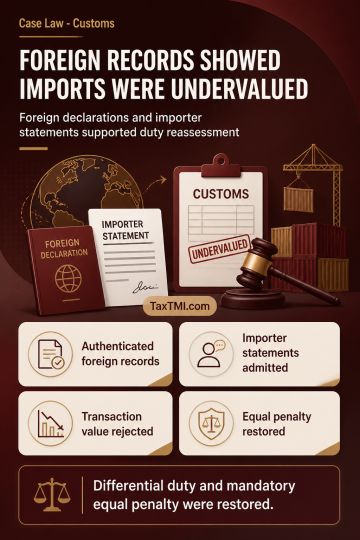
Foreign customs declarations and importer admissions established undervaluation, supporting sequential value redetermination, differential duty, and m...
Customs seizure safeguards prevent detention-based limitation avoidance and invalidate provisional release conditions for imported vehicles under an i...
Page of 4828
Press 'Enter' after typing page number.
361 to 380 of 96556 Results
❮
❯
❯❯
0 / 200
Expand Note
Add to Folder
No Folders have been created
+
Are you sure you want to delete "My most important" ?
Interest on the penalty amount - for the period when the initial order was stayed - The High Court observed that the regulations explicitly required the issuance of a demand notice after the penalty order's stipulated payment period had passed. The court found that this procedural step was not merely directory but mandatory, thus affecting the legality of the interest imposed without following due process. Additionally, the court noted analogous principles from tax law, where the issuance of a demand notice is a precondition for the recovery of sums due under the law. Drawing from these principles, the court underscored that proper legal procedures cannot be bypassed under the guise of procedural simplicity or regulatory power. The impugned order was set aside.
Interest on the penalty amount - for the period when the initial order was stayed - The High Court observed that the regulations explicitly required the issuance of a demand notice after the penalty order's stipulated payment period had passed. The court found that this procedural step was not merely directory but mandatory, thus affecting the legality of the interest imposed without following due process. Additionally, the court noted analogous principles from tax law, where the issuance of a demand notice is a precondition for the recovery of sums due under the law. Drawing from these principles, the court underscored that proper legal procedures cannot be bypassed under the guise of procedural simplicity or regulatory power. The impugned order was set aside.
Note: It is a system-generated summary and is for quick reference only.
 TaxTMI
  TaxTMI
 of 4828



















 Join Channel