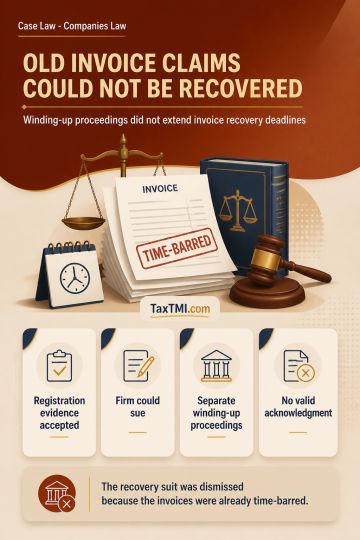
Invoice-based recovery claims remain time-barred despite separate winding-up proceedings, absent valid acknowledgment or part-payment of the disputed ...
Extended limitation fails without specific suppression allegations, while overseas employee secondment remains taxable as manpower supply within norma...
Time-share accommodation classification excludes Club or Association Service where purchasers receive contractual occupancy rights without genuine mem...
CENVAT credit for trading requires reversal, while taxable-service rental credit remains proportionately available and limitation issues await resolut...
Page of 4792
Press 'Enter' after typing page number.
61 to 80 of 95833 Results
❮
❯
❯❯
0 / 200
Expand Note
Add to Folder
No Folders have been created
+
Are you sure you want to delete "My most important" ?
Insolvency and BankruptcyApril 22, 2024Case LawsAT
Release of assets (machines) seized by the Customs Authorities before initiation of CIRP - The tribunal found that the goods were lawfully confiscated under the Customs Act before the initiation of the CIRP. Therefore, the goods were no longer the property of the Corporate Debtor by the time the RP sought their release. It was noted that the order for confiscation was made after a proper show-cause notice and was not contested by the Corporate Debtor at that time. - The tribunal clarified that the ownership of the confiscated goods vested with the government immediately upon confiscation, irrespective of whether the redemption fine was paid. The option to redeem the goods by paying the fine was a separate matter that did not affect the fundamental status of ownership transfer upon confiscation.
Release of assets (machines) seized by the Customs Authorities before initiation of CIRP - The tribunal found that the goods were lawfully confiscated under the Customs Act before the initiation of the CIRP. Therefore, the goods were no longer the property of the Corporate Debtor by the time the RP sought their release. It was noted that the order for confiscation was made after a proper show-cause notice and was not contested by the Corporate Debtor at that time. - The tribunal clarified that the ownership of the confiscated goods vested with the government immediately upon confiscation, irrespective of whether the redemption fine was paid. The option to redeem the goods by paying the fine was a separate matter that did not affect the fundamental status of ownership transfer upon confiscation.
Note: It is a system-generated summary and is for quick reference only.
 TaxTMI
 of 4792

















 Join Channel


 TaxTMI

