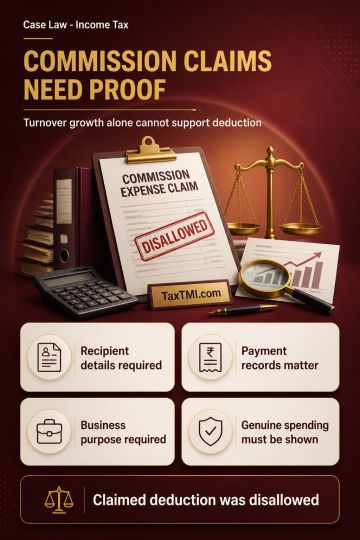
Business expenditure deduction requires proof of genuine commission payments and commercial allowability; turnover growth alone cannot validate the cl...
Article 8 treaty coverage excluded third-party airline support services, while documented demonetisation cash receipts remained accepted business inco...
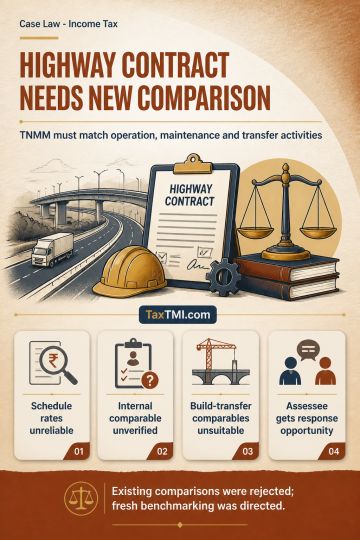
Functional comparability under TNMM requires highway contract benchmarks to reflect operation, maintenance and transfer activities, requiring fresh be...
Page of 4794
Press 'Enter' after typing page number.
401 to 420 of 95875 Results
❮
❯
❯❯
0 / 200
Expand Note
Add to Folder
No Folders have been created
+
Are you sure you want to delete "My most important" ?
Seeking grant of anticipatory bail - bailable offence or not - failure to make payment of tax - wilful attempt to evade any tax or payment of any tax - The applicant argued that the primary issue was tax evasion under MVAT, citing ongoing insolvency proceedings against a debtor as the reason for non-payment of taxes. - The High Court acknowledged the serious allegations of tax evasion and misappropriation, noting the substantial amount involved and the importance of custodial interrogation for a thorough investigation. - After analyzing relevant legal provisions and precedent cases, the Court concluded that the defendant could be prosecuted under both MVAT and IPC for the same set of facts. It cited Section 26 of the General Clauses Act to support this interpretation.
Seeking grant of anticipatory bail - bailable offence or not - failure to make payment of tax - wilful attempt to evade any tax or payment of any tax - The applicant argued that the primary issue was tax evasion under MVAT, citing ongoing insolvency proceedings against a debtor as the reason for non-payment of taxes. - The High Court acknowledged the serious allegations of tax evasion and misappropriation, noting the substantial amount involved and the importance of custodial interrogation for a thorough investigation. - After analyzing relevant legal provisions and precedent cases, the Court concluded that the defendant could be prosecuted under both MVAT and IPC for the same set of facts. It cited Section 26 of the General Clauses Act to support this interpretation.
Note: It is a system-generated summary and is for quick reference only.
 TaxTMI
 of 4794








 Join Channel


 TaxTMI