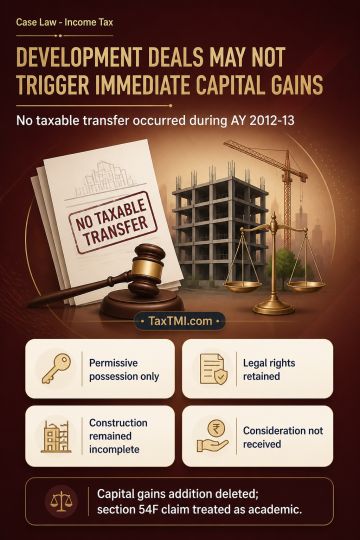
Development agreements require legal possession or effective enjoyment for capital gains transfer; permissive possession and deferred consideration de...
Prolonged sterilisation of development rights supports capital-gains treatment, while business-income disallowances cannot govern capital-gains comput...
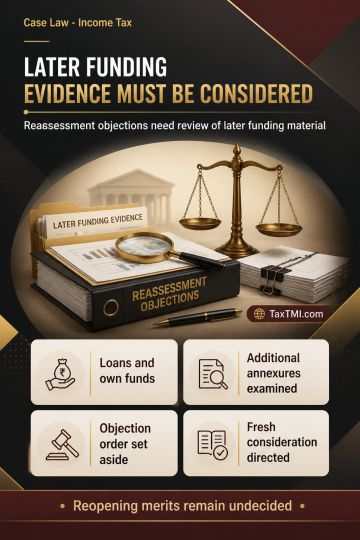
Additional evidence in transfer pricing dispute leads to fresh examination, while tax deductions, TDS credit, fee and refund interest require verifica...
Category II AIF pass-through taxation preserves non-business income character; investment receipts cannot be reclassified without applying recognised ...
Classification of goods - rate of tax - Classic Malabar Parota - Whole Wheat Malabar Parota - The court determined that the Malabar Parotas should not be classified under the heading 2106 as they are not akin to the other food preparations specified therein, which typically include items requiring more substantial processing. - The court highlighted that the 'bread' definition in the GST regime should be broadly interpreted to include varieties of bread prevalent in different cultures, including Indian flatbreads. - Ultimately, the court held that since Malabar Parotas are akin to items specified under tariff item 1905 9090, they should attract a GST of 5% (2.5% CGST + 2.5% SGST), as they are similar to products like Khakhra, plain chapati, or roti, which are also covered under this entry.
Classification of goods - rate of tax - Classic Malabar Parota - Whole Wheat Malabar Parota - The court determined that the Malabar Parotas should not be classified under the heading 2106 as they are not akin to the other food preparations specified therein, which typically include items requiring more substantial processing. - The court highlighted that the 'bread' definition in the GST regime should be broadly interpreted to include varieties of bread prevalent in different cultures, including Indian flatbreads. - Ultimately, the court held that since Malabar Parotas are akin to items specified under tariff item 1905 9090, they should attract a GST of 5% (2.5% CGST + 2.5% SGST), as they are similar to products like Khakhra, plain chapati, or roti, which are also covered under this entry.
Note: It is a system-generated summary and is for quick reference only.
 TaxTMI
  TaxTMI
 of 4807













 Join Channel


