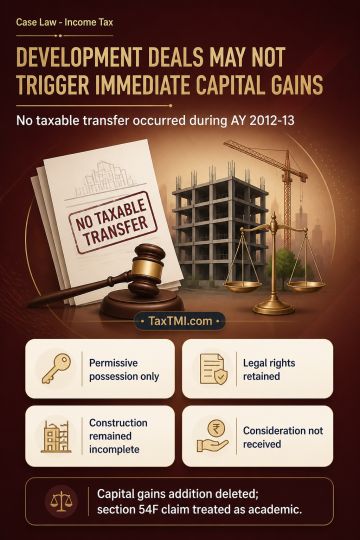
Development agreements require legal possession or effective enjoyment for capital gains transfer; permissive possession and deferred consideration de...
Prolonged sterilisation of development rights supports capital-gains treatment, while business-income disallowances cannot govern capital-gains comput...
Additional evidence in transfer pricing dispute leads to fresh examination, while tax deductions, TDS credit, fee and refund interest require verifica...
Category II AIF pass-through taxation preserves non-business income character; investment receipts cannot be reclassified without applying recognised ...
Income tax proceedings against company dissolved / insolvent - Jurisdiction or authority to reopen or assess income for any period prior to the approval of the Resolution Plan - The High Court affirmed that once a Resolution Plan is approved under the IBC, it becomes binding on all stakeholders, including creditors and guarantors, extinguishing liabilities prior to its approval. Relying on Supreme Court judgments, the Court reiterated that the legislative intent behind Section 31 of the IBC is to provide a fresh start to the successful resolution applicant, safeguarding against surprise claims. The Court dismissed attempts to distinguish between voluntary and involuntary insolvency, emphasizing that the protection afforded under Section 31 applies uniformly.
Income tax proceedings against company dissolved / insolvent - Jurisdiction or authority to reopen or assess income for any period prior to the approval of the Resolution Plan - The High Court affirmed that once a Resolution Plan is approved under the IBC, it becomes binding on all stakeholders, including creditors and guarantors, extinguishing liabilities prior to its approval. Relying on Supreme Court judgments, the Court reiterated that the legislative intent behind Section 31 of the IBC is to provide a fresh start to the successful resolution applicant, safeguarding against surprise claims. The Court dismissed attempts to distinguish between voluntary and involuntary insolvency, emphasizing that the protection afforded under Section 31 applies uniformly.
Note: It is a system-generated summary and is for quick reference only.
 TaxTMI
 of 4800
















 Join Channel


 TaxTMI
