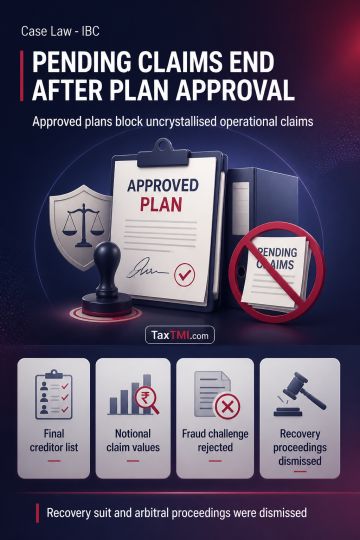
Clean slate principle extinguishes uncrystallised operational claims and bars continuation of pending recovery and arbitral proceedings after plan app...
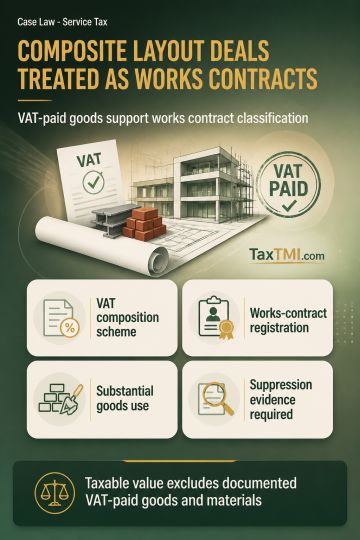
Works contract classification governs composite layout-development contracts where VAT-paid goods are transferred alongside construction and infrastru...
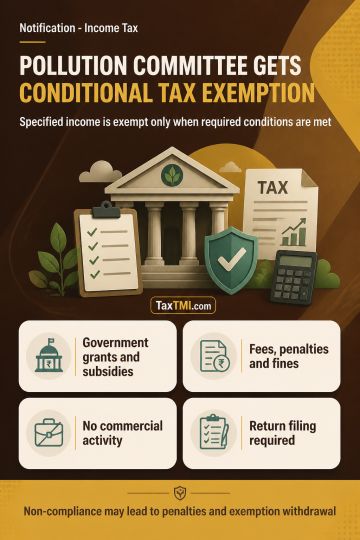
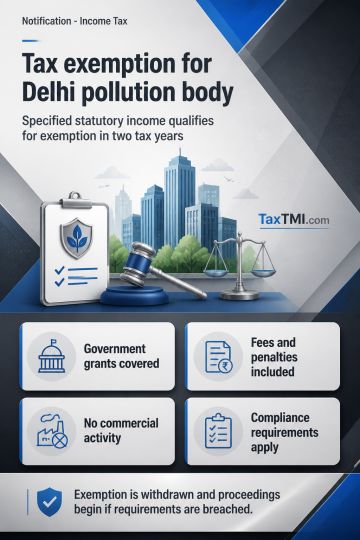
Specified income tax exemption for pollution control body remains conditional on non-commercial activity, unchanged income character, and return filin...
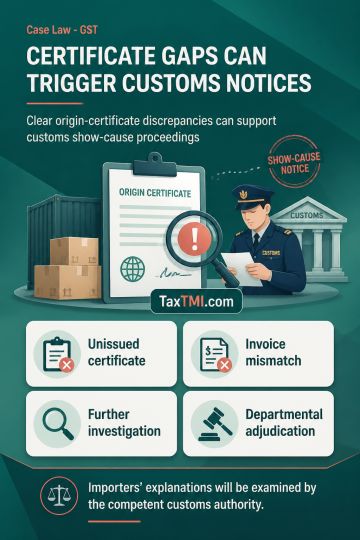
Jurisdictional facts in certificate-of-origin discrepancies can support customs show-cause proceedings, leaving factual explanations for departmental ...
Income tax proceedings against company dissolved / insolvent - Jurisdiction or authority to reopen or assess income for any period prior to the approval of the Resolution Plan - The High Court affirmed that once a Resolution Plan is approved under the IBC, it becomes binding on all stakeholders, including creditors and guarantors, extinguishing liabilities prior to its approval. Relying on Supreme Court judgments, the Court reiterated that the legislative intent behind Section 31 of the IBC is to provide a fresh start to the successful resolution applicant, safeguarding against surprise claims. The Court dismissed attempts to distinguish between voluntary and involuntary insolvency, emphasizing that the protection afforded under Section 31 applies uniformly.
Income tax proceedings against company dissolved / insolvent - Jurisdiction or authority to reopen or assess income for any period prior to the approval of the Resolution Plan - The High Court affirmed that once a Resolution Plan is approved under the IBC, it becomes binding on all stakeholders, including creditors and guarantors, extinguishing liabilities prior to its approval. Relying on Supreme Court judgments, the Court reiterated that the legislative intent behind Section 31 of the IBC is to provide a fresh start to the successful resolution applicant, safeguarding against surprise claims. The Court dismissed attempts to distinguish between voluntary and involuntary insolvency, emphasizing that the protection afforded under Section 31 applies uniformly.
Note: It is a system-generated summary and is for quick reference only.
 TaxTMI
 of 4796





 Join Channel


 TaxTMI