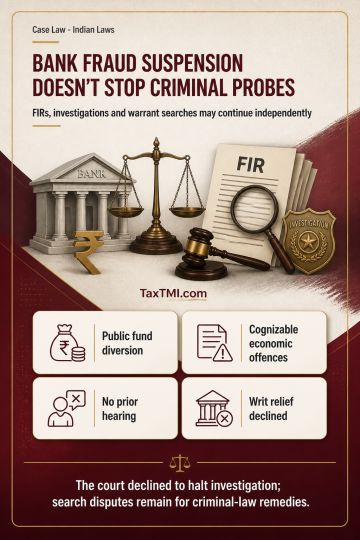
Administrative fraud classification suspension does not halt independent criminal investigation or warrant-based searches into alleged economic offenc...
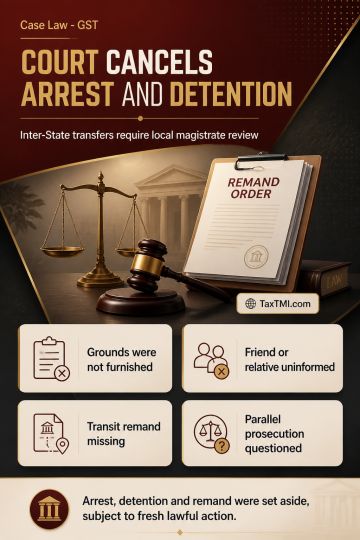
Arrest safeguards and transit remand requirements invalidated detention following inter-State transfer without communicated grounds or magistrate auth...
Arrest safeguards require disclosed grounds, relative intimation and transit remand, while duplicate prosecution under the CGST framework is unsustain...
Document Identification Number defects can invalidate GST assessments, with delayed challenges entertained conditionally where patent irregularities e...
Penalties u/s 112 and section 114AA of Customs Act, 1962 - classification of goods imported under duty exemption entitlement certificate (DEEC) scheme - The tribunal finds fault with the reclassification adopted in the impugned order, as it fails to specify the tariff item and associated rate of duty, as required by the Customs Act. Moreover, the tribunal highlights the lack of clarity in distinguishing between alloy and non-alloy steel and criticizes the simultaneous application of valuation rules, which runs counter to prescribed procedures. The tribunal concludes that the reclassification lacks legal validity. - Due to foundational lacunae and subsequent developments, the tribunal sets aside the order and directs a rehearing of the matter, allowing both parties to present their arguments afresh.
Penalties u/s 112 and section 114AA of Customs Act, 1962 - classification of goods imported under duty exemption entitlement certificate (DEEC) scheme - The tribunal finds fault with the reclassification adopted in the impugned order, as it fails to specify the tariff item and associated rate of duty, as required by the Customs Act. Moreover, the tribunal highlights the lack of clarity in distinguishing between alloy and non-alloy steel and criticizes the simultaneous application of valuation rules, which runs counter to prescribed procedures. The tribunal concludes that the reclassification lacks legal validity. - Due to foundational lacunae and subsequent developments, the tribunal sets aside the order and directs a rehearing of the matter, allowing both parties to present their arguments afresh.
Note: It is a system-generated summary and is for quick reference only.
 TaxTMI
 of 4803









 Join Channel


 TaxTMI
