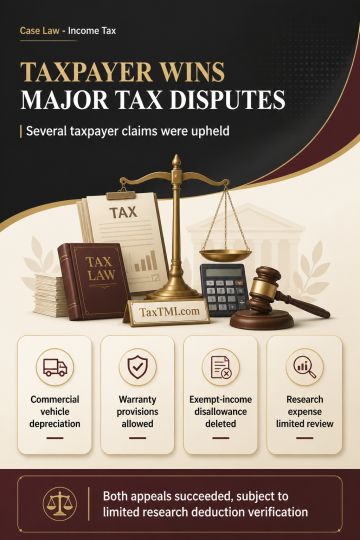
Commercial vehicle depreciation, scientifically determined warranty provisions and exempt-income disallowances were resolved in favour of the taxpayer...
Inherited property sale proceeds require capital-gains treatment where ownership is supported by evidence, not suspicion or unverified signature doubt...
Cross-examination of retracted statements is essential where foundational evidence supports a benami allegation and documented funding explanations re...
Capital-goods exemption covers plant-modernisation accessories, while the import restriction applies only to earlier capital-goods components and spar...
Penalties u/s 112 and section 114AA of Customs Act, 1962 - classification of goods imported under duty exemption entitlement certificate (DEEC) scheme - The tribunal finds fault with the reclassification adopted in the impugned order, as it fails to specify the tariff item and associated rate of duty, as required by the Customs Act. Moreover, the tribunal highlights the lack of clarity in distinguishing between alloy and non-alloy steel and criticizes the simultaneous application of valuation rules, which runs counter to prescribed procedures. The tribunal concludes that the reclassification lacks legal validity. - Due to foundational lacunae and subsequent developments, the tribunal sets aside the order and directs a rehearing of the matter, allowing both parties to present their arguments afresh.
Penalties u/s 112 and section 114AA of Customs Act, 1962 - classification of goods imported under duty exemption entitlement certificate (DEEC) scheme - The tribunal finds fault with the reclassification adopted in the impugned order, as it fails to specify the tariff item and associated rate of duty, as required by the Customs Act. Moreover, the tribunal highlights the lack of clarity in distinguishing between alloy and non-alloy steel and criticizes the simultaneous application of valuation rules, which runs counter to prescribed procedures. The tribunal concludes that the reclassification lacks legal validity. - Due to foundational lacunae and subsequent developments, the tribunal sets aside the order and directs a rehearing of the matter, allowing both parties to present their arguments afresh.
Note: It is a system-generated summary and is for quick reference only.
 TaxTMI
 of 4800











 Join Channel


 TaxTMI