Transfer pricing and tax deductions upheld on established principles, while employee contributions and warranty provisions returned for fresh examinat...
Captive transfer pricing relies on industrial consumer tariffs, while genuine quotations can benchmark effluent treatment transfers under the Other Me...
Specific tariff classification for ophthalmic instruments and extended limitation principles determine the treatment of duty demands, confiscation, an...
Integrated golf function determines classification, placing launch monitors and simulators under other golf equipment rather than measuring instrument...
Public servant status under anti-corruption law extends to recognised stock exchange leadership; constitutional and sanction challenges do not succeed...
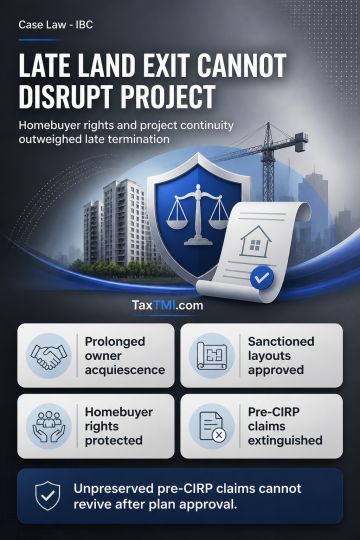
Acquiescence, homebuyer protection and clean-slate resolution principles prevent landowners from disrupting an integrated project through late termina...
Seeking directions against the respondent no. 1/National Housing Bank (NHB) to consider and decide upon the petitioner’s representation - The High Court noted that the petitioner's representation primarily aimed at collecting information to use in litigation before the National Company Law Appellate Tribunal (NCLAT), rather than seeking redressal of any immediate legal or constitutional rights. The Court emphasized that writ jurisdiction cannot be employed as a means to gather evidence against a party involved in pending disputes. It cited legal precedents to highlight that courts are not forums for roving inquiries or fact-finding missions. Concluding that the petitioner's petition was a misuse and abuse of the court's process, the Court dismissed the petition along with the pending application.
Seeking directions against the respondent no. 1/National Housing Bank (NHB) to consider and decide upon the petitioner’s representation - The High Court noted that the petitioner's representation primarily aimed at collecting information to use in litigation before the National Company Law Appellate Tribunal (NCLAT), rather than seeking redressal of any immediate legal or constitutional rights. The Court emphasized that writ jurisdiction cannot be employed as a means to gather evidence against a party involved in pending disputes. It cited legal precedents to highlight that courts are not forums for roving inquiries or fact-finding missions. Concluding that the petitioner's petition was a misuse and abuse of the court's process, the Court dismissed the petition along with the pending application.
Note: It is a system-generated summary and is for quick reference only.
 TaxTMI
 of 4803














 Join Channel


 TaxTMI