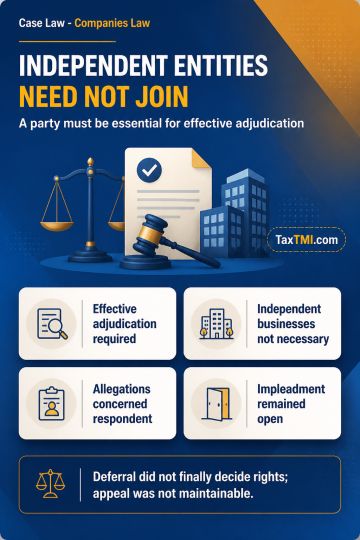
Necessary-party requirements limit impleadment of independent entities, while deferred consideration does not create an appealable adverse determinati...
Food supplement classification requires common parlance and authoritative tests, preventing treatment as proprietary Ayurvedic medicines without suppo...
Specified regulatory authority income receives conditional tax exemption, subject to non-commercial activity, unchanged income character, and return f...
Tax exemption for regulatory authority income applies retrospectively, subject to non-commercial activity, unchanged income sources, and return-filing...
Input tax credit conditions remain constitutionally valid, with eligible recipient claims considered under GST circulars and retrospective filing dead...
Exemption u/s 11 - rejection of assessee’s application for registration u/s 12A - The Appellate Tribunal found that the rejection of the application was unjustified as it was based on suspicion without credible material. It emphasized that at the registration stage, the focus should be on determining whether the objectives of the institution are charitable, rather than questioning the expenditure incurred. It was observed that while the Commissioner did not doubt the charitable nature of the institution's objectives, the rejection was primarily based on concerns about promoting pharmaceutical businesses. However, the Tribunal asserted that educating and raising awareness about diseases like endocrine disorders is inherently charitable.
Exemption u/s 11 - rejection of assessee’s application for registration u/s 12A - The Appellate Tribunal found that the rejection of the application was unjustified as it was based on suspicion without credible material. It emphasized that at the registration stage, the focus should be on determining whether the objectives of the institution are charitable, rather than questioning the expenditure incurred. It was observed that while the Commissioner did not doubt the charitable nature of the institution's objectives, the rejection was primarily based on concerns about promoting pharmaceutical businesses. However, the Tribunal asserted that educating and raising awareness about diseases like endocrine disorders is inherently charitable.
Note: It is a system-generated summary and is for quick reference only.
 TaxTMI
 of 4805



















 Join Channel


 TaxTMI