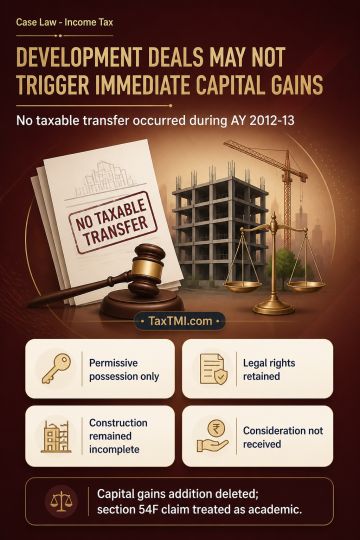
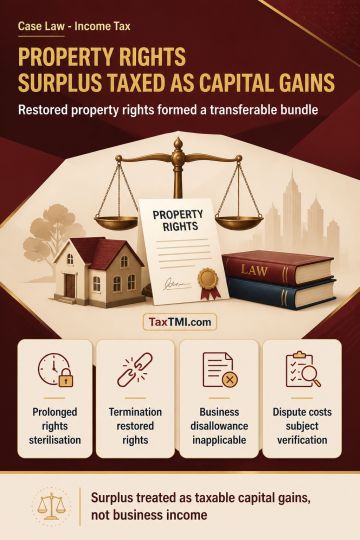
Development agreements require legal possession or effective enjoyment for capital gains transfer; permissive possession and deferred consideration de...
Prolonged sterilisation of development rights supports capital-gains treatment, while business-income disallowances cannot govern capital-gains comput...
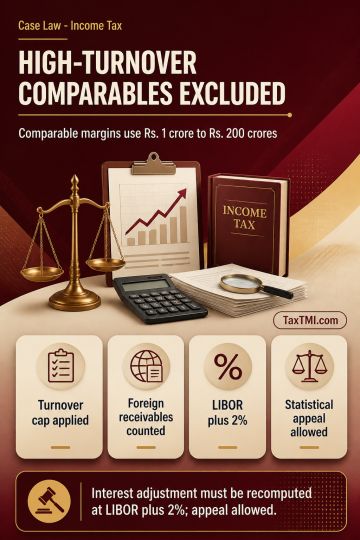
Additional evidence in transfer pricing dispute leads to fresh examination, while tax deductions, TDS credit, fee and refund interest require verifica...
Category II AIF pass-through taxation preserves non-business income character; investment receipts cannot be reclassified without applying recognised ...
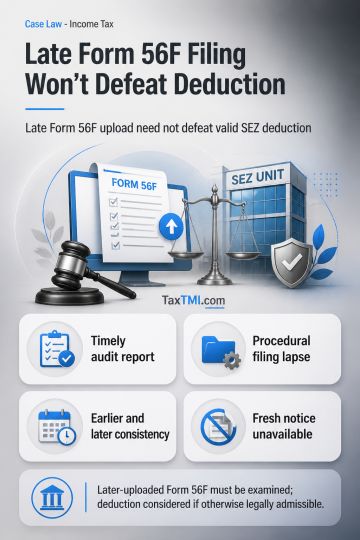
Deductions u/s 80IC - audit report in Form 10 CCB, due to inadvertence, had not been uploaded online on time - Power of CBDT to condone delay us 119 - Rectification u/s 154 - The High Court observed that the tax authority's failure to act on the rectification request for nearly six years constituted an unreasonable refusal to exercise its statutory powers, thereby violating its duty. Errors made by the petitioner’s Chartered Accountants should not prejudice the petitioner's entitlement to statutory deductions, echoing the principle that the objective of the law is not to penalize taxpayers for inadvertent errors. The court rejected a narrow interpretation of 'genuine hardship' that would only consider severe financial crises, highlighting that the loss of statutory benefits itself constitutes a genuine hardship.
Deductions u/s 80IC - audit report in Form 10 CCB, due to inadvertence, had not been uploaded online on time - Power of CBDT to condone delay us 119 - Rectification u/s 154 - The High Court observed that the tax authority's failure to act on the rectification request for nearly six years constituted an unreasonable refusal to exercise its statutory powers, thereby violating its duty. Errors made by the petitioner’s Chartered Accountants should not prejudice the petitioner's entitlement to statutory deductions, echoing the principle that the objective of the law is not to penalize taxpayers for inadvertent errors. The court rejected a narrow interpretation of 'genuine hardship' that would only consider severe financial crises, highlighting that the loss of statutory benefits itself constitutes a genuine hardship.
Note: It is a system-generated summary and is for quick reference only.
 TaxTMI
  TaxTMI
 of 4816








 Join Channel




