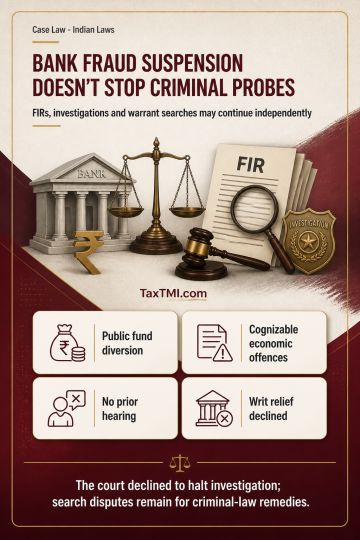
Administrative fraud classification suspension does not halt independent criminal investigation or warrant-based searches into alleged economic offenc...
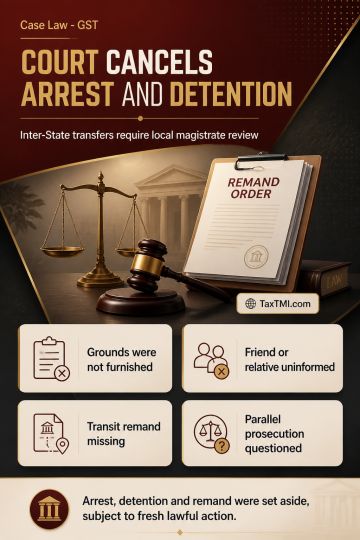
Arrest safeguards and transit remand requirements invalidated detention following inter-State transfer without communicated grounds or magistrate auth...
Arrest safeguards require disclosed grounds, relative intimation and transit remand, while duplicate prosecution under the CGST framework is unsustain...
Document Identification Number defects can invalidate GST assessments, with delayed challenges entertained conditionally where patent irregularities e...
Deductions u/s 80IC - audit report in Form 10 CCB, due to inadvertence, had not been uploaded online on time - Power of CBDT to condone delay us 119 - Rectification u/s 154 - The High Court observed that the tax authority's failure to act on the rectification request for nearly six years constituted an unreasonable refusal to exercise its statutory powers, thereby violating its duty. Errors made by the petitioner’s Chartered Accountants should not prejudice the petitioner's entitlement to statutory deductions, echoing the principle that the objective of the law is not to penalize taxpayers for inadvertent errors. The court rejected a narrow interpretation of 'genuine hardship' that would only consider severe financial crises, highlighting that the loss of statutory benefits itself constitutes a genuine hardship.
Deductions u/s 80IC - audit report in Form 10 CCB, due to inadvertence, had not been uploaded online on time - Power of CBDT to condone delay us 119 - Rectification u/s 154 - The High Court observed that the tax authority's failure to act on the rectification request for nearly six years constituted an unreasonable refusal to exercise its statutory powers, thereby violating its duty. Errors made by the petitioner’s Chartered Accountants should not prejudice the petitioner's entitlement to statutory deductions, echoing the principle that the objective of the law is not to penalize taxpayers for inadvertent errors. The court rejected a narrow interpretation of 'genuine hardship' that would only consider severe financial crises, highlighting that the loss of statutory benefits itself constitutes a genuine hardship.
Note: It is a system-generated summary and is for quick reference only.
 TaxTMI
  TaxTMI
 of 4811









 Join Channel




