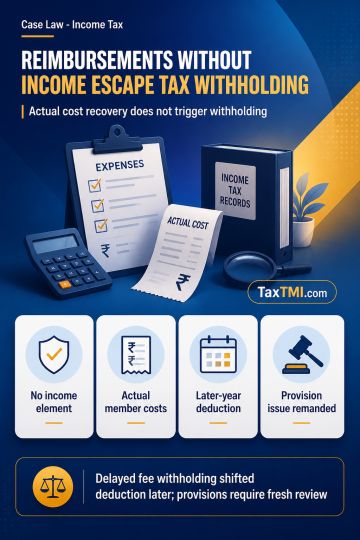
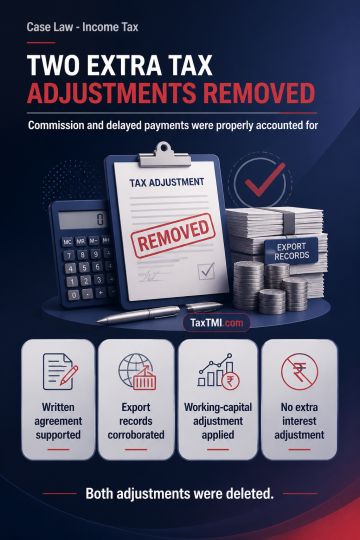
Pure reimbursement without income element escapes tax withholding, while delayed withholding and unsupported provisions face deferred or renewed scrut...
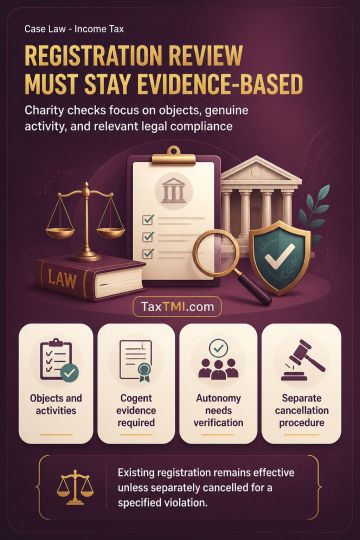
Public benefit requirement defeats charitable registration where residents' association services are reciprocal, member-only facilities governed by mu...
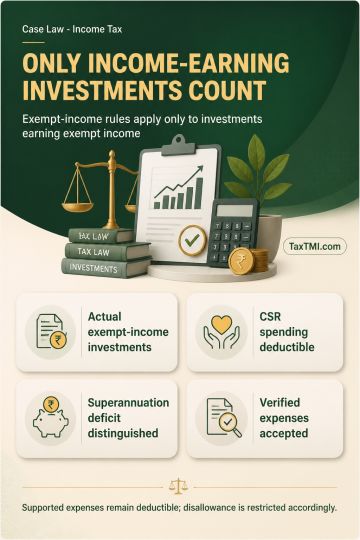
Exempt-income expenditure disallowance is confined to investments that actually generated exempt income, while supported business expenses remain dedu...
Objective characteristics and principal use govern mining-tyre classification, while fresh advance ruling applications may rely on additional technica...
Deductions u/s 80IC - audit report in Form 10 CCB, due to inadvertence, had not been uploaded online on time - Power of CBDT to condone delay us 119 - Rectification u/s 154 - The High Court observed that the tax authority's failure to act on the rectification request for nearly six years constituted an unreasonable refusal to exercise its statutory powers, thereby violating its duty. Errors made by the petitioner’s Chartered Accountants should not prejudice the petitioner's entitlement to statutory deductions, echoing the principle that the objective of the law is not to penalize taxpayers for inadvertent errors. The court rejected a narrow interpretation of 'genuine hardship' that would only consider severe financial crises, highlighting that the loss of statutory benefits itself constitutes a genuine hardship.
Deductions u/s 80IC - audit report in Form 10 CCB, due to inadvertence, had not been uploaded online on time - Power of CBDT to condone delay us 119 - Rectification u/s 154 - The High Court observed that the tax authority's failure to act on the rectification request for nearly six years constituted an unreasonable refusal to exercise its statutory powers, thereby violating its duty. Errors made by the petitioner’s Chartered Accountants should not prejudice the petitioner's entitlement to statutory deductions, echoing the principle that the objective of the law is not to penalize taxpayers for inadvertent errors. The court rejected a narrow interpretation of 'genuine hardship' that would only consider severe financial crises, highlighting that the loss of statutory benefits itself constitutes a genuine hardship.
Note: It is a system-generated summary and is for quick reference only.
 TaxTMI
  TaxTMI
 of 4811






 Join Channel


