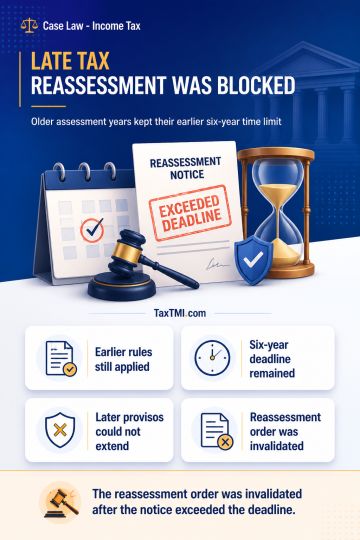
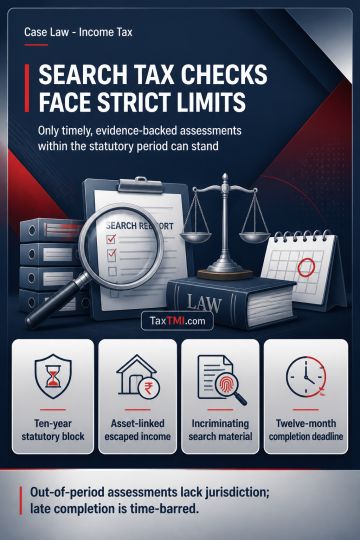
Pre-amendment reassessment limitation bars late notices under the preserved regime, invalidating consequential reassessment for affected earlier asses...
Cash-sales explanations for bank deposits require documentary reconciliation; reassessment notice survived where effective response time was available...
Functional comparability in transfer pricing prevents ad hoc arm's length adjustments where functions, assets, risks and reliable comparables are unes...
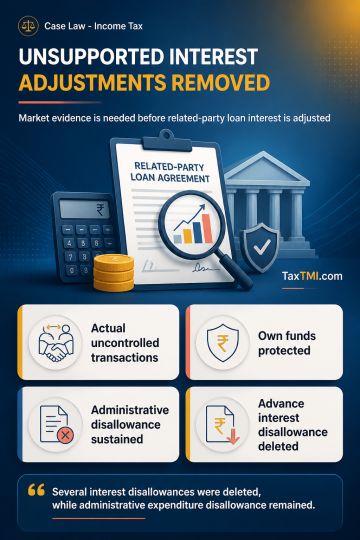
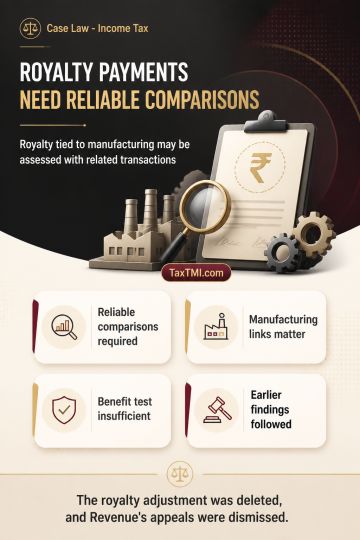
Contingency expenses, exempt-income disallowance, and royalty benchmarking: unsupported adjustments were deleted under consistent accounting and trans...
Page of 4921
Press 'Enter' after typing page number.
81 to 100 of 98414 Results
❮
❯
❯❯
0 / 200
Expand Note
Add to Folder
No Folders have been created
+
Are you sure you want to delete "My most important" ?
Rejection of branch transfer / Stock transfer of Goods - The tribunal found that the tax authority inappropriately applied a general conclusion from a small subset of transactions to all transfers, without adequate individual evidence. - The tribunal referenced several precedents that clarify when a movement of goods between states constitutes a sale versus a transfer. The key determination hinges on whether there is a direct link between customer orders and the movement of goods. - Ultimately, the tribunal sided with the company for most of the disputed transactions, reversing the additional tax demand. It held that the burden of proof to demonstrate that these were not branch transfers but sales rested with the State, which it failed to meet except in a limited number of transactions.
Rejection of branch transfer / Stock transfer of Goods - The tribunal found that the tax authority inappropriately applied a general conclusion from a small subset of transactions to all transfers, without adequate individual evidence. - The tribunal referenced several precedents that clarify when a movement of goods between states constitutes a sale versus a transfer. The key determination hinges on whether there is a direct link between customer orders and the movement of goods. - Ultimately, the tribunal sided with the company for most of the disputed transactions, reversing the additional tax demand. It held that the burden of proof to demonstrate that these were not branch transfers but sales rested with the State, which it failed to meet except in a limited number of transactions.
Note: It is a system-generated summary and is for quick reference only.
 TaxTMI
 TaxTMI

 of 4921