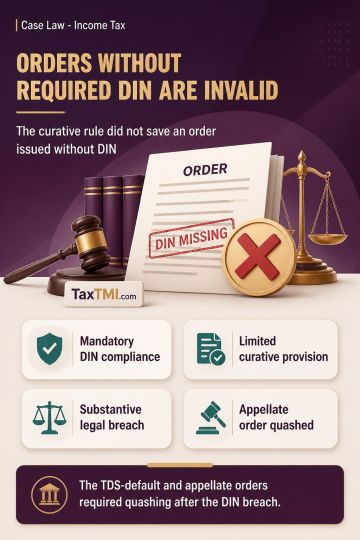
Document Identification Number compliance renders TDS-default orders invalid where mandatory DIN requirements are breached and curative provision does...
Prospective or Retrospective application of amendment to the provisions of the Act and Rules - The High Court touched upon the principle that delegated legislation, unless explicitly retrospective, does not impair vested rights. However, it clarified that legislation clarifying or explaining existing laws can have retrospective effect, particularly if it fills legislative gaps or clarifies ambiguities. In this context, Rule 37 was seen as clarifying rather than altering the law's essence, thus applicable to pending applications like that of the appellant.
Prospective or Retrospective application of amendment to the provisions of the Act and Rules - The High Court touched upon the principle that delegated legislation, unless explicitly retrospective, does not impair vested rights. However, it clarified that legislation clarifying or explaining existing laws can have retrospective effect, particularly if it fills legislative gaps or clarifies ambiguities. In this context, Rule 37 was seen as clarifying rather than altering the law's essence, thus applicable to pending applications like that of the appellant.
Note: It is a system-generated summary and is for quick reference only.
 TaxTMI
  TaxTMI
 of 4918