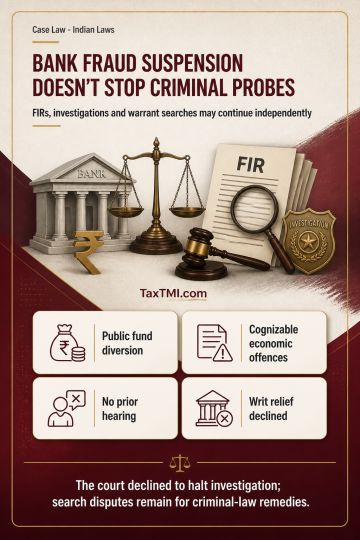
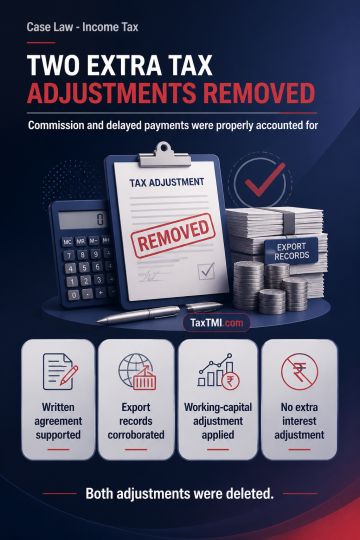
Pure reimbursement without income element escapes tax withholding, while delayed withholding and unsupported provisions face deferred or renewed scrut...
Public benefit requirement defeats charitable registration where residents' association services are reciprocal, member-only facilities governed by mu...
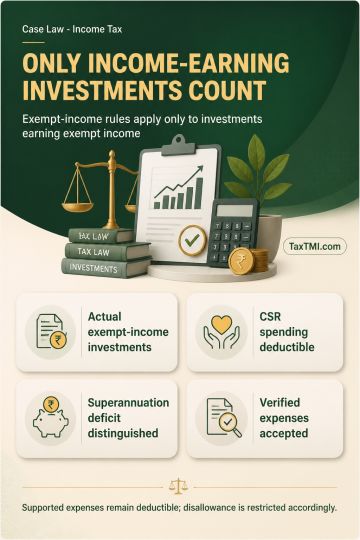
Exempt-income expenditure disallowance is confined to investments that actually generated exempt income, while supported business expenses remain dedu...
Objective characteristics and principal use govern mining-tyre classification, while fresh advance ruling applications may rely on additional technica...
Administrative fraud classification suspension does not halt independent criminal investigation or warrant-based searches into alleged economic offenc...
Page of 4794
Press 'Enter' after typing page number.
621 to 640 of 95875 Results
❮
❯
❯❯
0 / 200
Expand Note
Add to Folder
No Folders have been created
+
Are you sure you want to delete "My most important" ?
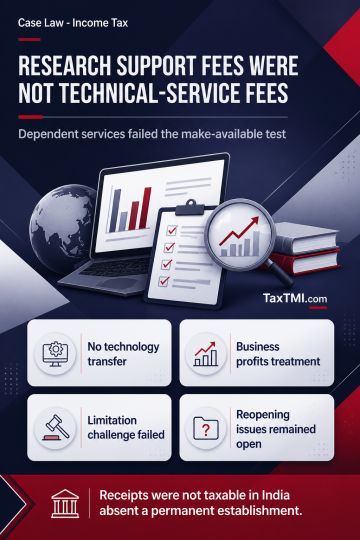
Taxability in India of receipts of foreign AEs - Fee for Technical Services (FTS) - Master Service Agreement relied upon - The Tribunal extensively reviewed the MSA, emphasizing that it established an independent contractor relationship between the Indian entity and its foreign counterparts. It highlighted that the foreign entities had ownership of the intellectual property developed, bore the risk of performance, and had an obligation to indemnify the Indian entity for errors or performance issues. - The ITAT's ruling clarifies the distinction between revenue sharing from a consolidated project and FTS, reinforcing the principle that the nature of the payment depends on the underlying contractual relationships and the actual conduct of parties. - It was held that payments made by HCLT to the foreign AEs could not be construed as FTS.
Taxability in India of receipts of foreign AEs - Fee for Technical Services (FTS) - Master Service Agreement relied upon - The Tribunal extensively reviewed the MSA, emphasizing that it established an independent contractor relationship between the Indian entity and its foreign counterparts. It highlighted that the foreign entities had ownership of the intellectual property developed, bore the risk of performance, and had an obligation to indemnify the Indian entity for errors or performance issues. - The ITAT's ruling clarifies the distinction between revenue sharing from a consolidated project and FTS, reinforcing the principle that the nature of the payment depends on the underlying contractual relationships and the actual conduct of parties. - It was held that payments made by HCLT to the foreign AEs could not be construed as FTS.
Note: It is a system-generated summary and is for quick reference only.
 TaxTMI
 of 4794














 Join Channel


 TaxTMI