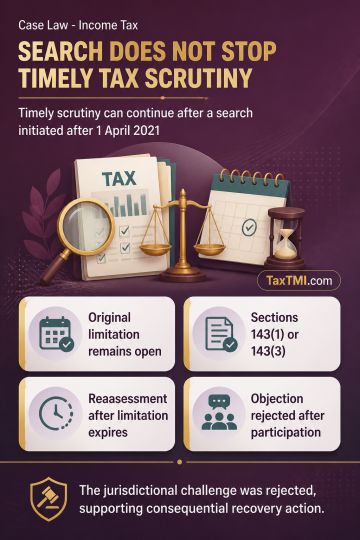
Post-search scrutiny assessment remains available where original assessment limitation is unexpired, permitting timely completion under regular assess...
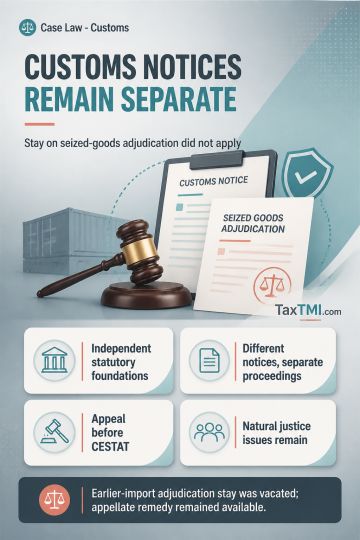
Independent show-cause notices remain separate proceedings, while customs adjudication challenges should ordinarily follow the statutory appellate rem...
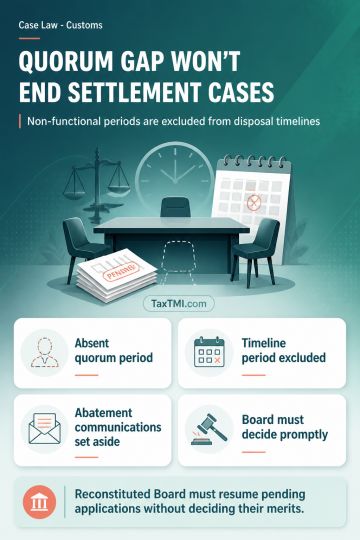
Institutional incapacity in customs settlement proceedings excludes non-functional quorum periods from statutory disposal timelines, preventing automa...
Page of 4788
Press 'Enter' after typing page number.
121 to 140 of 95749 Results
❮
❯
❯❯
0 / 200
Expand Note
Add to Folder
No Folders have been created
+
Are you sure you want to delete "My most important" ?
Dishonour of cheque - Respondent (accused) denied issuing the cheques and claimed they were taken from his office by the complainant. - The Trial Court found the ledger produced by the complainant to be inadmissible as it lacked a certificate u/s 65B of the Evidence Act. - The Trial Court held that since the signatures on the cheques were admitted by the respondent, the presumption u/s 138 would arise. - The Trial Court found that the accused had raised a probable defense by asserting that he used to sell goods to the complainant and the cheques were not issued for any legally recoverable debt or liability. - The High Court emphasized the limited scope of interference in appeals against acquittals, stating that unless the view taken by the Trial Court is impossible or perverse, interference is not warranted.
Dishonour of cheque - Respondent (accused) denied issuing the cheques and claimed they were taken from his office by the complainant. - The Trial Court found the ledger produced by the complainant to be inadmissible as it lacked a certificate u/s 65B of the Evidence Act. - The Trial Court held that since the signatures on the cheques were admitted by the respondent, the presumption u/s 138 would arise. - The Trial Court found that the accused had raised a probable defense by asserting that he used to sell goods to the complainant and the cheques were not issued for any legally recoverable debt or liability. - The High Court emphasized the limited scope of interference in appeals against acquittals, stating that unless the view taken by the Trial Court is impossible or perverse, interference is not warranted.
Note: It is a system-generated summary and is for quick reference only.
 TaxTMI
 of 4788





 Join Channel


 TaxTMI