Inherited property sale proceeds require capital-gains treatment where ownership is supported by evidence, not suspicion or unverified signature doubt...
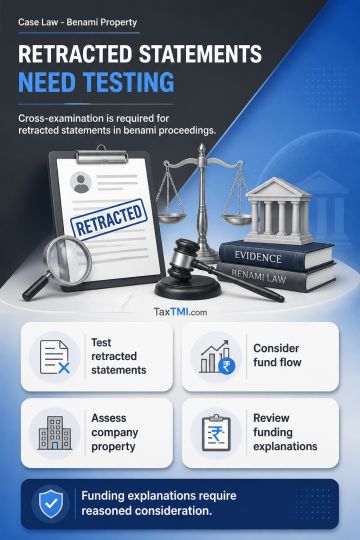
Cross-examination of retracted statements is essential where foundational evidence supports a benami allegation and documented funding explanations re...
Capital-goods exemption covers plant-modernisation accessories, while the import restriction applies only to earlier capital-goods components and spar...
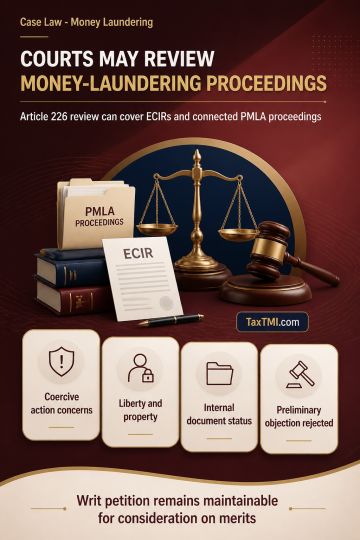
Constitutional judicial review permits challenges to ECIRs and connected money-laundering proceedings where coercive action affects fundamental intere...
Dishonour of cheque - Respondent (accused) denied issuing the cheques and claimed they were taken from his office by the complainant. - The Trial Court found the ledger produced by the complainant to be inadmissible as it lacked a certificate u/s 65B of the Evidence Act. - The Trial Court held that since the signatures on the cheques were admitted by the respondent, the presumption u/s 138 would arise. - The Trial Court found that the accused had raised a probable defense by asserting that he used to sell goods to the complainant and the cheques were not issued for any legally recoverable debt or liability. - The High Court emphasized the limited scope of interference in appeals against acquittals, stating that unless the view taken by the Trial Court is impossible or perverse, interference is not warranted.
Dishonour of cheque - Respondent (accused) denied issuing the cheques and claimed they were taken from his office by the complainant. - The Trial Court found the ledger produced by the complainant to be inadmissible as it lacked a certificate u/s 65B of the Evidence Act. - The Trial Court held that since the signatures on the cheques were admitted by the respondent, the presumption u/s 138 would arise. - The Trial Court found that the accused had raised a probable defense by asserting that he used to sell goods to the complainant and the cheques were not issued for any legally recoverable debt or liability. - The High Court emphasized the limited scope of interference in appeals against acquittals, stating that unless the view taken by the Trial Court is impossible or perverse, interference is not warranted.
Note: It is a system-generated summary and is for quick reference only.
 TaxTMI
 of 4788













 Join Channel


 TaxTMI