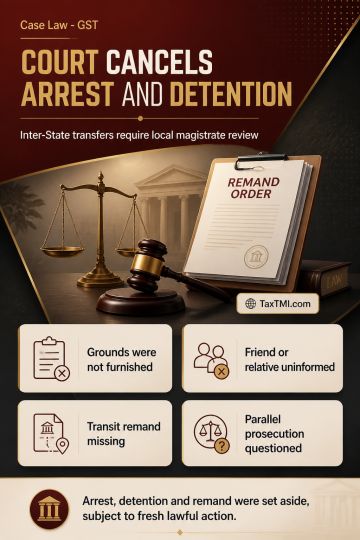
Arrest safeguards and transit remand requirements invalidated detention following inter-State transfer without communicated grounds or magistrate auth...
Arrest safeguards require disclosed grounds, relative intimation and transit remand, while duplicate prosecution under the CGST framework is unsustain...
Document Identification Number defects can invalidate GST assessments, with delayed challenges entertained conditionally where patent irregularities e...
Windmill commissioning evidence supported higher depreciation where grid connection and electricity generation proved operational use before the relev...
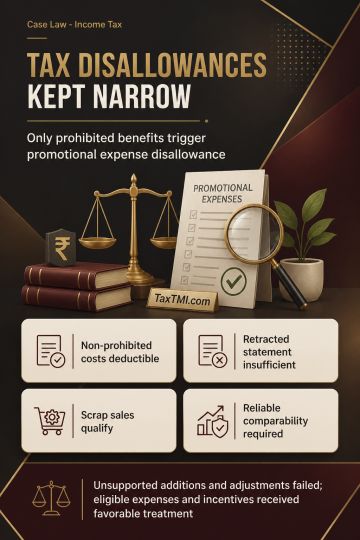
Pharmaceutical promotion and transfer-pricing comparability principles limited disallowances, while uncorroborated search allegations and unsupported ...
Page of 4796
Press 'Enter' after typing page number.
661 to 680 of 95918 Results
❮
❯
❯❯
0 / 200
Expand Note
Add to Folder
No Folders have been created
+
Are you sure you want to delete "My most important" ?
The High Court affirmed the independence of proceedings under the PMLA, clarifying that while the outcome of the scheduled offense may have some bearing on the PMLA case, the prosecution must independently prove the allegations under the PMLA. - The Court criticized the complainant for presuming that the scheduled offense automatically generated proceeds of crime, emphasizing the need for independent proof. It noted deficiencies in the evidence presented by the prosecution, particularly regarding the source of the alleged proceeds of crime. - Ultimately, the High Court concluded that the appeal lacked merit and upheld the trial court's decision to dismiss the complaint. It emphasized that an acquittal should not be disturbed unless there are serious legal infirmities or factual errors, which were not present in this case.
The High Court affirmed the independence of proceedings under the PMLA, clarifying that while the outcome of the scheduled offense may have some bearing on the PMLA case, the prosecution must independently prove the allegations under the PMLA. - The Court criticized the complainant for presuming that the scheduled offense automatically generated proceeds of crime, emphasizing the need for independent proof. It noted deficiencies in the evidence presented by the prosecution, particularly regarding the source of the alleged proceeds of crime. - Ultimately, the High Court concluded that the appeal lacked merit and upheld the trial court's decision to dismiss the complaint. It emphasized that an acquittal should not be disturbed unless there are serious legal infirmities or factual errors, which were not present in this case.
Note: It is a system-generated summary and is for quick reference only.
 TaxTMI
 of 4796



















 Join Channel


 TaxTMI