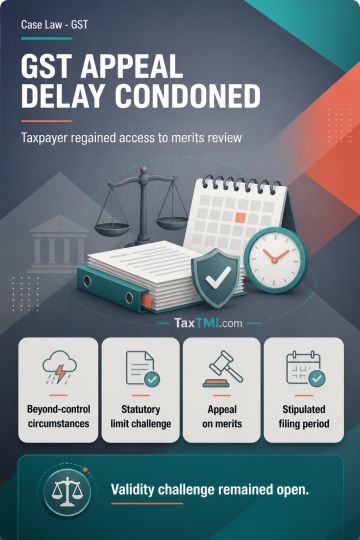
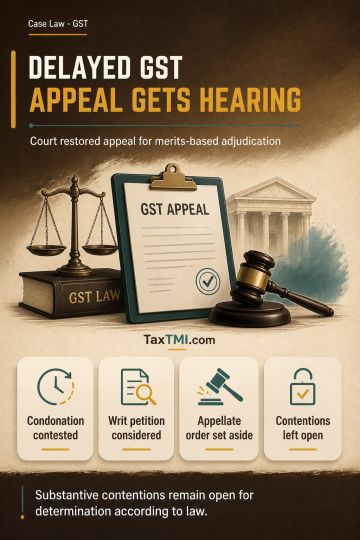
Input tax credit conditions remain constitutionally valid, with eligible recipient claims considered under GST circulars and retrospective filing dead...
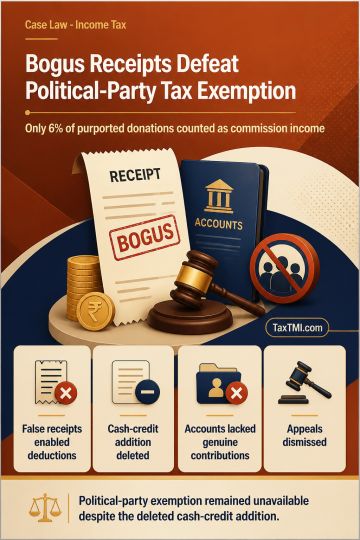
Bogus donation receipts justified commission income assessment and defeated political-party tax exemption for inaccurate accounts and reporting failur...
Pure reimbursement without income element escapes tax withholding, while delayed withholding and unsupported provisions face deferred or renewed scrut...
Public benefit requirement defeats charitable registration where residents' association services are reciprocal, member-only facilities governed by mu...
Exempt-income expenditure disallowance is confined to investments that actually generated exempt income, while supported business expenses remain dedu...
Page of 4796
Press 'Enter' after typing page number.
621 to 640 of 95918 Results
❮
❯
❯❯
0 / 200
Expand Note
Add to Folder
No Folders have been created
+
Are you sure you want to delete "My most important" ?
The High Court affirmed the independence of proceedings under the PMLA, clarifying that while the outcome of the scheduled offense may have some bearing on the PMLA case, the prosecution must independently prove the allegations under the PMLA. - The Court criticized the complainant for presuming that the scheduled offense automatically generated proceeds of crime, emphasizing the need for independent proof. It noted deficiencies in the evidence presented by the prosecution, particularly regarding the source of the alleged proceeds of crime. - Ultimately, the High Court concluded that the appeal lacked merit and upheld the trial court's decision to dismiss the complaint. It emphasized that an acquittal should not be disturbed unless there are serious legal infirmities or factual errors, which were not present in this case.
The High Court affirmed the independence of proceedings under the PMLA, clarifying that while the outcome of the scheduled offense may have some bearing on the PMLA case, the prosecution must independently prove the allegations under the PMLA. - The Court criticized the complainant for presuming that the scheduled offense automatically generated proceeds of crime, emphasizing the need for independent proof. It noted deficiencies in the evidence presented by the prosecution, particularly regarding the source of the alleged proceeds of crime. - Ultimately, the High Court concluded that the appeal lacked merit and upheld the trial court's decision to dismiss the complaint. It emphasized that an acquittal should not be disturbed unless there are serious legal infirmities or factual errors, which were not present in this case.
Note: It is a system-generated summary and is for quick reference only.
 TaxTMI
 of 4796


















 Join Channel


 TaxTMI