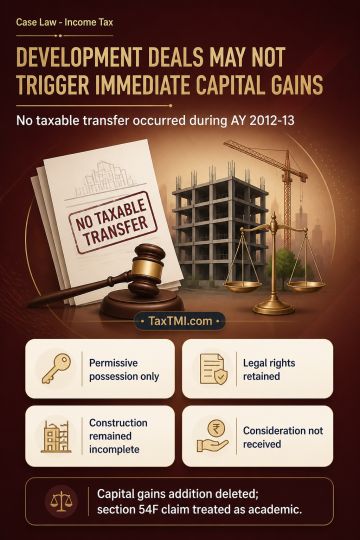
Development agreements require legal possession or effective enjoyment for capital gains transfer; permissive possession and deferred consideration de...
Prolonged sterilisation of development rights supports capital-gains treatment, while business-income disallowances cannot govern capital-gains comput...
Additional evidence in transfer pricing dispute leads to fresh examination, while tax deductions, TDS credit, fee and refund interest require verifica...
Category II AIF pass-through taxation preserves non-business income character; investment receipts cannot be reclassified without applying recognised ...
Mutual fund maturity rules require proper rollover, redemption, disclosure, and due diligence; investor gains cannot excuse regulatory breaches or pen...
Page of 4809
Press 'Enter' after typing page number.
1381 to 1400 of 96177 Results
❮
❯
❯❯
0 / 200
Expand Note
Add to Folder
No Folders have been created
+
Are you sure you want to delete "My most important" ?
Clarification on TCS liability under section 52 of the DGST Act, 2017 in case of multiple E-commerce Operators in one transaction - The circular clarifies the TCS liability under section 52 of the DGST Act concerning transactions involving multiple ECOs. It distinguishes between scenarios where the supplier-side ECO is and isn't the direct supplier, attributing TCS compliance to the entity responsible for remitting payment to the supplier. In cases where the supplier-side ECO acts solely as a facilitator, it bears the TCS burden, whereas, when the supplier-side ECO is also the supplier, the buyer-side ECO assumes TCS collection responsibilities.
Clarification on TCS liability under section 52 of the DGST Act, 2017 in case of multiple E-commerce Operators in one transaction - The circular clarifies the TCS liability under section 52 of the DGST Act concerning transactions involving multiple ECOs. It distinguishes between scenarios where the supplier-side ECO is and isn't the direct supplier, attributing TCS compliance to the entity responsible for remitting payment to the supplier. In cases where the supplier-side ECO acts solely as a facilitator, it bears the TCS burden, whereas, when the supplier-side ECO is also the supplier, the buyer-side ECO assumes TCS collection responsibilities.
Note: It is a system-generated summary and is for quick reference only.
 TaxTMI
  TaxTMI
 of 4809

















 Join Channel




