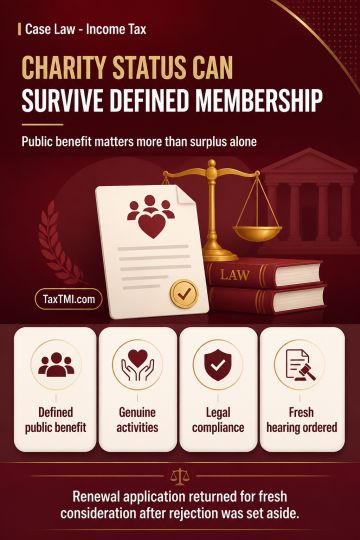
Defined public benefit can retain charitable character; registration renewal requires examining genuine activities and legal compliance, not surplus a...
Capital reduction is distinct from share buy-back, preventing buy-back tax; restructuring interest and related business deductions also survive scruti...
Transfer pricing and tax deductions upheld on established principles, while employee contributions and warranty provisions returned for fresh examinat...
Captive transfer pricing relies on industrial consumer tariffs, while genuine quotations can benchmark effluent treatment transfers under the Other Me...
Specific tariff classification for ophthalmic instruments and extended limitation principles determine the treatment of duty demands, confiscation, an...
Levy of penalty equivalent to the tax on employees - wrongful utilization of Input Tax Credit - The High Court scrutinized the applicability of Sections 122(1A) and 137 of the CGST Act to the petitioners, emphasizing that these sections target "taxable persons" and entities responsible for the conduct of a company's business. It was determined that individual employees, who do not stand to personally benefit from the tax credits or evasion in question, do not fall within the scope of these sections as applied in the show cause notice. - It was clarified that the petitioners, in their capacity as employees, could not be deemed directly responsible for the alleged tax evasion merely based on their roles within the company, especially in the absence of concrete proof of their direct involvement or benefit from the evasion.
Levy of penalty equivalent to the tax on employees - wrongful utilization of Input Tax Credit - The High Court scrutinized the applicability of Sections 122(1A) and 137 of the CGST Act to the petitioners, emphasizing that these sections target "taxable persons" and entities responsible for the conduct of a company's business. It was determined that individual employees, who do not stand to personally benefit from the tax credits or evasion in question, do not fall within the scope of these sections as applied in the show cause notice. - It was clarified that the petitioners, in their capacity as employees, could not be deemed directly responsible for the alleged tax evasion merely based on their roles within the company, especially in the absence of concrete proof of their direct involvement or benefit from the evasion.
Note: It is a system-generated summary and is for quick reference only.
 TaxTMI
 of 4805

















 Join Channel


 TaxTMI

