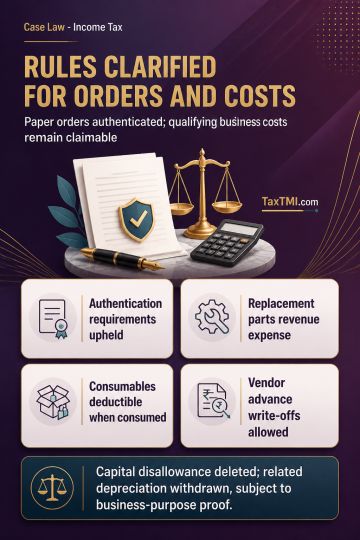
Authentication of paper assessment orders upheld, while qualifying repairs, consumables and vendor advance write-offs remain deductible business claim...
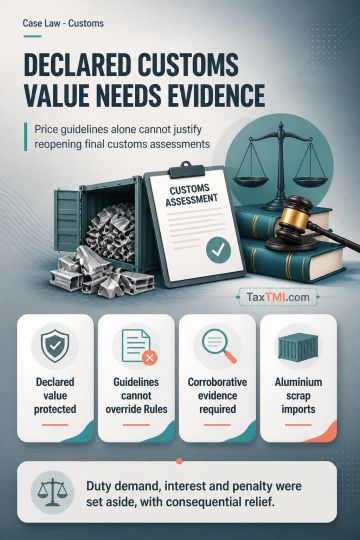
Transaction value cannot be rejected solely on non-statutory valuation guidelines without corroborative evidence supporting reassessment of final cust...
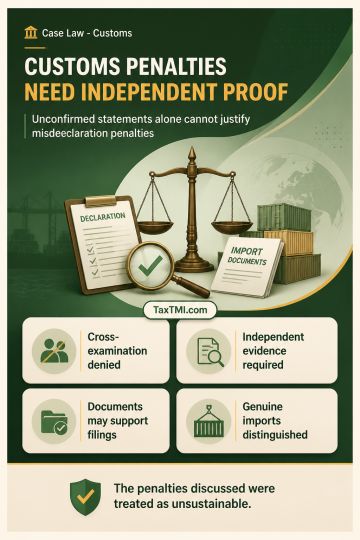
Cross-examination rights and corroborated evidence limit customs penalties for misdeclaration in genuine import transactions involving documented clea...
Tariff classification of vehicle gear components follows the specific gearing entry, displacing motor-vehicle parts classification and related liabili...
Levy of penalty equivalent to the tax on employees - wrongful utilization of Input Tax Credit - The High Court scrutinized the applicability of Sections 122(1A) and 137 of the CGST Act to the petitioners, emphasizing that these sections target "taxable persons" and entities responsible for the conduct of a company's business. It was determined that individual employees, who do not stand to personally benefit from the tax credits or evasion in question, do not fall within the scope of these sections as applied in the show cause notice. - It was clarified that the petitioners, in their capacity as employees, could not be deemed directly responsible for the alleged tax evasion merely based on their roles within the company, especially in the absence of concrete proof of their direct involvement or benefit from the evasion.
Levy of penalty equivalent to the tax on employees - wrongful utilization of Input Tax Credit - The High Court scrutinized the applicability of Sections 122(1A) and 137 of the CGST Act to the petitioners, emphasizing that these sections target "taxable persons" and entities responsible for the conduct of a company's business. It was determined that individual employees, who do not stand to personally benefit from the tax credits or evasion in question, do not fall within the scope of these sections as applied in the show cause notice. - It was clarified that the petitioners, in their capacity as employees, could not be deemed directly responsible for the alleged tax evasion merely based on their roles within the company, especially in the absence of concrete proof of their direct involvement or benefit from the evasion.
Note: It is a system-generated summary and is for quick reference only.
 TaxTMI
 of 4805








 Join Channel


 TaxTMI

