Statutory transfer formalities invalidated alleged share and property transfers, while retrospective record manipulation constituted oppression and mi...
Provisional attachment of laundered funds and equivalent-value property sustained, with statutory protection limited to pension, gratuity and providen...
Insolvency moratorium does not shield company officers from cheque dishonour prosecution for liability arising before corporate insolvency proceedings...
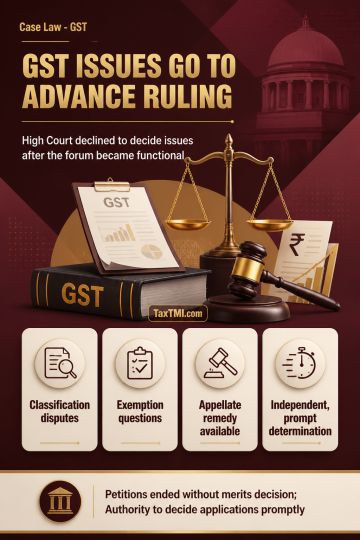
Advance-ruling mechanism governs pending GST classification, exemption and taxability disputes, limiting writ review once the specialised forum functi...
Page of 4805
Press 'Enter' after typing page number.
921 to 940 of 96092 Results
❮
❯
❯❯
0 / 200
Expand Note
Add to Folder
No Folders have been created
+
Are you sure you want to delete "My most important" ?
Sanction of composite scheme of amalgamation - The appellants contested the order, arguing that it failed to consider certain clauses of the scheme, particularly regarding separability. They sought approval for part D of the scheme, excluding parts B and C, which had been automatically revoked due to non-approval by relevant shareholders. - The Tribunal examined the issues raised and found that the impugned order did not adequately address the separability of the scheme. It recognized the appellants' argument for separability and the Tribunal's discretion to modify arrangements for proper implementation. - Consequently the Tribunal set aside the impugned order and directed the NCLT to reconsider the application for the second motion, taking into account the observations made.
Sanction of composite scheme of amalgamation - The appellants contested the order, arguing that it failed to consider certain clauses of the scheme, particularly regarding separability. They sought approval for part D of the scheme, excluding parts B and C, which had been automatically revoked due to non-approval by relevant shareholders. - The Tribunal examined the issues raised and found that the impugned order did not adequately address the separability of the scheme. It recognized the appellants' argument for separability and the Tribunal's discretion to modify arrangements for proper implementation. - Consequently the Tribunal set aside the impugned order and directed the NCLT to reconsider the application for the second motion, taking into account the observations made.
Note: It is a system-generated summary and is for quick reference only.
 TaxTMI
 of 4805




















 Join Channel


 TaxTMI