Opportunity to respond to jurisdictional reports is mandatory before customs settlement duty enhancement; connected applications require consistent ad...
Specific customs headings for scaffolding components prevail over general classification, invalidating misclassification proceedings and enabling with...
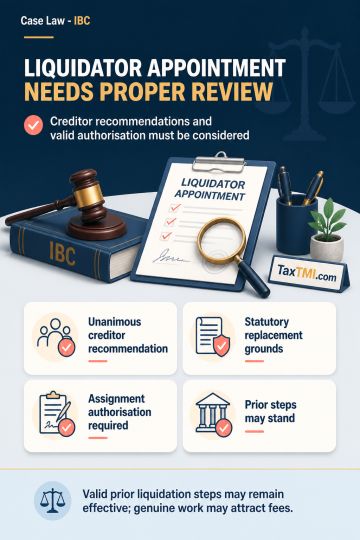
Liquidator appointment under Section 34 requires consideration of creditor recommendations, valid professional authorisation, and preservation of vali...
Income-tax exemption for specified regulatory fees and government grants applies subject to non-commercial activity and continuing compliance conditio...
Digital accessibility audit and remediation deadlines extended, while all other disability-compliance obligations for regulated entities remain unchan...
Page of 4803
Press 'Enter' after typing page number.
621 to 640 of 96047 Results
❮
❯
❯❯
0 / 200
Expand Note
Add to Folder
No Folders have been created
+
Are you sure you want to delete "My most important" ?
Sanction of composite scheme of amalgamation - The appellants contested the order, arguing that it failed to consider certain clauses of the scheme, particularly regarding separability. They sought approval for part D of the scheme, excluding parts B and C, which had been automatically revoked due to non-approval by relevant shareholders. - The Tribunal examined the issues raised and found that the impugned order did not adequately address the separability of the scheme. It recognized the appellants' argument for separability and the Tribunal's discretion to modify arrangements for proper implementation. - Consequently the Tribunal set aside the impugned order and directed the NCLT to reconsider the application for the second motion, taking into account the observations made.
Sanction of composite scheme of amalgamation - The appellants contested the order, arguing that it failed to consider certain clauses of the scheme, particularly regarding separability. They sought approval for part D of the scheme, excluding parts B and C, which had been automatically revoked due to non-approval by relevant shareholders. - The Tribunal examined the issues raised and found that the impugned order did not adequately address the separability of the scheme. It recognized the appellants' argument for separability and the Tribunal's discretion to modify arrangements for proper implementation. - Consequently the Tribunal set aside the impugned order and directed the NCLT to reconsider the application for the second motion, taking into account the observations made.
Note: It is a system-generated summary and is for quick reference only.
 TaxTMI
 of 4803

















 Join Channel


 TaxTMI