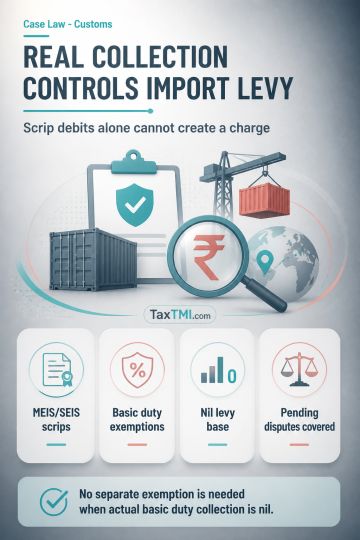
Country of Origin Certificates and declared transaction value supported preferential customs exemption where authenticity and invoice prices remained ...
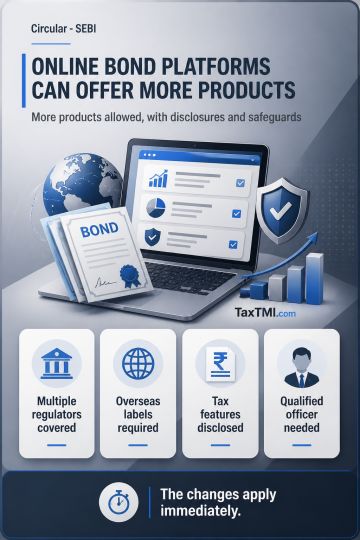
Online bond platforms may offer overseas-regulated products and tax-specific bonds subject to disclosures, compliance safeguards and revised complianc...
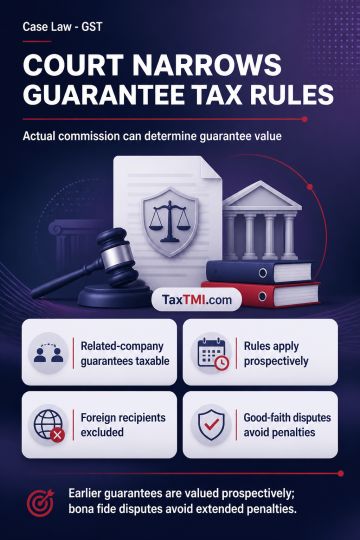
Corporate guarantee valuation permits actual ascertainable commission while barring retroactive application and extended-period penalties for bona fid...
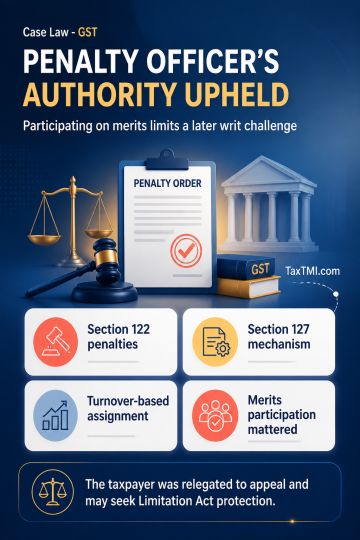
Proper-officer jurisdiction under UPGST penalty provisions upheld; participation on merits prevents bypassing the statutory appellate remedy through w...
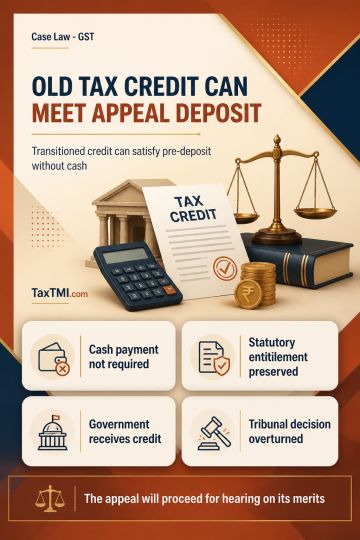
Transitioned CENVAT credit may validly satisfy mandatory pre-deposit requirements for legacy service tax appeals through Electronic Credit Ledger debi...
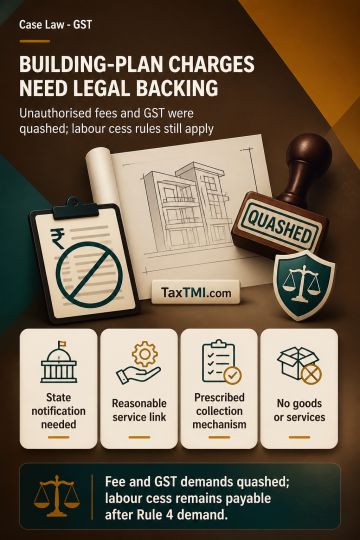
Building-plan sanction charges require statutory authority; unauthorised fees and GST were quashed, while labour cess must follow prescribed collectio...
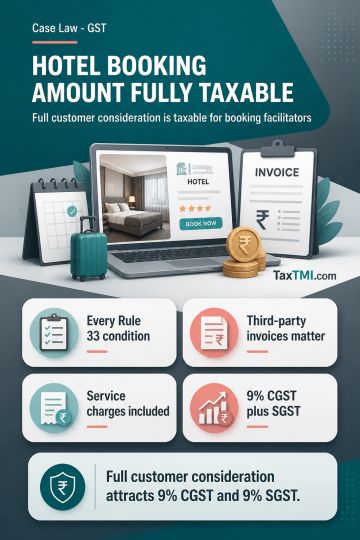
Pure-agent exclusion fails where hotel booking facilitators receive third-party services themselves, making entire customer consideration taxable as r...
Page of 4814
Press 'Enter' after typing page number.
381 to 400 of 96262 Results
❮
❯
❯❯
0 / 200
Expand Note
Add to Folder
No Folders have been created
+
Are you sure you want to delete "My most important" ?
Income taxable in India or not - Taxation of Technical Collaboration Fees @ 10% u/s. 9(1)(vii) r.w.s 115A(1)(b) - The Appellate Tribunal considered the arguments presented by both parties and examined relevant provisions of the Income Tax Act and the India-Mauritius tax treaty. It noted that the assessee, being a foreign company, did not have a permanent establishment (PE) in India. Additionally, there was no specific clause in the tax treaty addressing the taxability of the income in question. - ITAT held that in the absence of a permanent establishment and specific treaty provisions, the income should be treated as business profits and is not taxable in India.
Income taxable in India or not - Taxation of Technical Collaboration Fees @ 10% u/s. 9(1)(vii) r.w.s 115A(1)(b) - The Appellate Tribunal considered the arguments presented by both parties and examined relevant provisions of the Income Tax Act and the India-Mauritius tax treaty. It noted that the assessee, being a foreign company, did not have a permanent establishment (PE) in India. Additionally, there was no specific clause in the tax treaty addressing the taxability of the income in question. - ITAT held that in the absence of a permanent establishment and specific treaty provisions, the income should be treated as business profits and is not taxable in India.
Note: It is a system-generated summary and is for quick reference only.
 TaxTMI
  TaxTMI
 of 4814






 Join Channel