Charitable registration renewal cannot become an assessment of receipts, profitability or annual exemption compliance, requiring renewal and donation ...
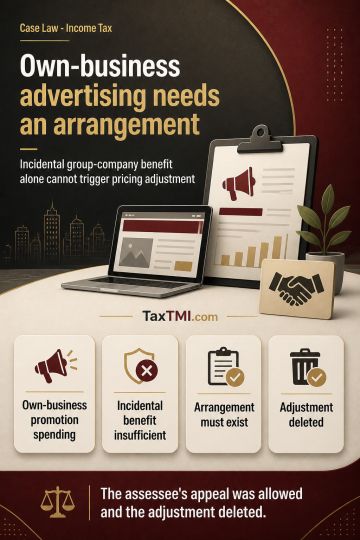
AMP expenditure for own business is not an international transaction without an associated-enterprise arrangement, eliminating transfer pricing adjust...
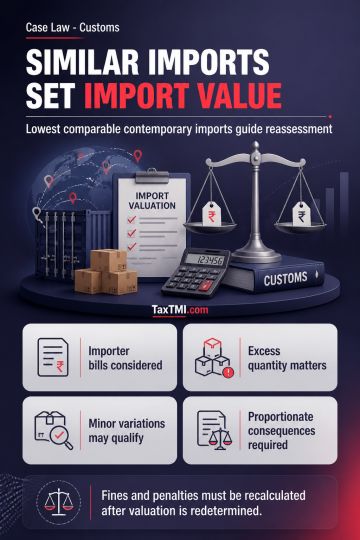
Customs valuation must use comparable contemporary imports, while confiscation fines and penalties require proportionate recalculation on reassessed v...
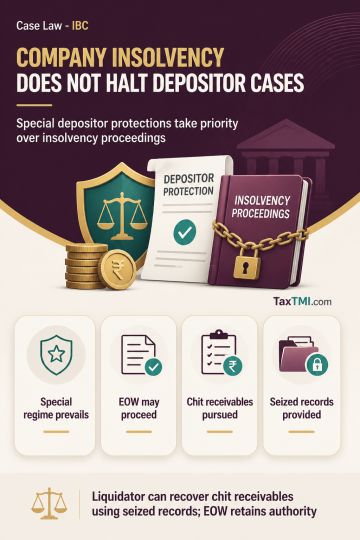
Depositor-protection proceedings prevail over corporate insolvency, while liquidators may recover chit receivables using copies of seized company reco...
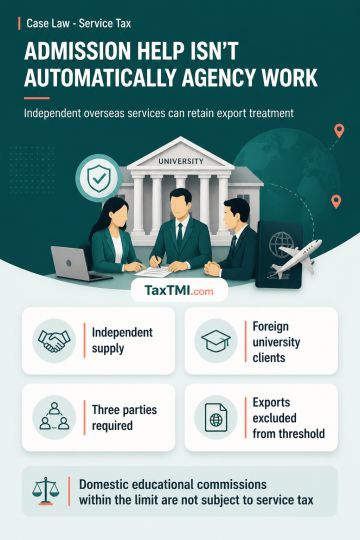
Intermediary service classification fails where overseas admission facilitation is supplied independently, preserving export treatment and small-provi...
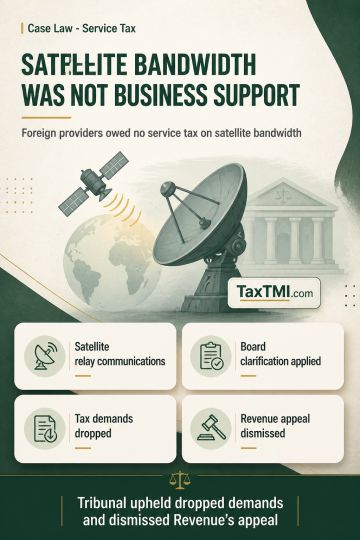
Satellite transponder bandwidth is telecommunication, not Business Support Service; foreign non-telegraph providers triggered no service tax liability...
Page of 4824
Press 'Enter' after typing page number.
441 to 460 of 96463 Results
❮
❯
❯❯
0 / 200
Expand Note
Add to Folder
No Folders have been created
+
Are you sure you want to delete "My most important" ?
Release of goods in terms of the provision of Section 129(1)(a) of the GST / UPGST Act 2017 - SCN issued to the petitioner in its capacity as the consignee - The High Court acknowledged the petitioner's status as the consignee of the goods but emphasized their position as the registered owner. It concurred that, as per Section 129(1)(a) of the U.P.G.S.T. Act 2017, the goods are liable to be released in favor of the registered owner, which in this case, is the petitioner. The Court upheld the petitioner's right to obtain the release of goods.
Release of goods in terms of the provision of Section 129(1)(a) of the GST / UPGST Act 2017 - SCN issued to the petitioner in its capacity as the consignee - The High Court acknowledged the petitioner's status as the consignee of the goods but emphasized their position as the registered owner. It concurred that, as per Section 129(1)(a) of the U.P.G.S.T. Act 2017, the goods are liable to be released in favor of the registered owner, which in this case, is the petitioner. The Court upheld the petitioner's right to obtain the release of goods.
Note: It is a system-generated summary and is for quick reference only.
 TaxTMI
  TaxTMI
 of 4824





 Join Channel


