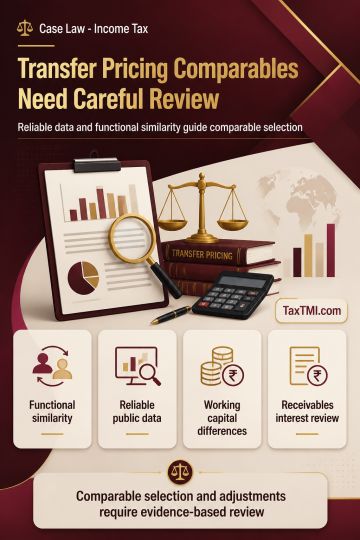
Transfer pricing comparability requires functional alignment, reliable financial data, and careful review of working capital and receivables adjustmen...
Transfer pricing rules require benchmarking corporate guarantees and associated-enterprise advances, while invalid domestic-transaction adjustments ca...
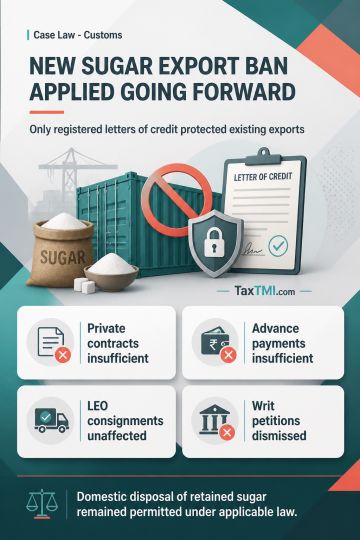
Prospective sugar export prohibition required registered letters of credit; private contracts and export quotas created no enforceable continuation ri...
Retroactive interim-moratorium exclusion permits protective asset disclosure and preservation measures against personal guarantors pending arbitration...
Page of 4778
Press 'Enter' after typing page number.
61 to 80 of 95557 Results
❮
❯
❯❯
0 / 200
Expand Note
Add to Folder
No Folders have been created
+
Are you sure you want to delete "My most important" ?
The Reserve Bank of India (RBI) issued Circular, addressing Scheduled Commercial Banks, Primary (Urban) Cooperative Banks, State Cooperative Banks, and Exim Bank regarding the Interest Equalization Scheme (IES) on Pre and Post Shipment Rupee Export Credit. The circular extends the Scheme until June 30, 2024, with revised interest rates. Notably, the Scheme now offers 2% interest equalization for Manufacturers and Merchant Exporters and 3% for MSME manufacturers. However, certain modifications have been advised, including restrictions on banks with an average interest rate higher than Repo Rate + 4% and a cap on the subvention amount.
The Reserve Bank of India (RBI) issued Circular, addressing Scheduled Commercial Banks, Primary (Urban) Cooperative Banks, State Cooperative Banks, and Exim Bank regarding the Interest Equalization Scheme (IES) on Pre and Post Shipment Rupee Export Credit. The circular extends the Scheme until June 30, 2024, with revised interest rates. Notably, the Scheme now offers 2% interest equalization for Manufacturers and Merchant Exporters and 3% for MSME manufacturers. However, certain modifications have been advised, including restrictions on banks with an average interest rate higher than Repo Rate + 4% and a cap on the subvention amount.
Note: It is a system-generated summary and is for quick reference only.
 TaxTMI
 of 4778











 Join Channel


 TaxTMI