Defined public benefit can retain charitable character; registration renewal requires examining genuine activities and legal compliance, not surplus a...
Capital reduction is distinct from share buy-back, preventing buy-back tax; restructuring interest and related business deductions also survive scruti...
Transfer pricing and tax deductions upheld on established principles, while employee contributions and warranty provisions returned for fresh examinat...
Captive transfer pricing relies on industrial consumer tariffs, while genuine quotations can benchmark effluent treatment transfers under the Other Me...
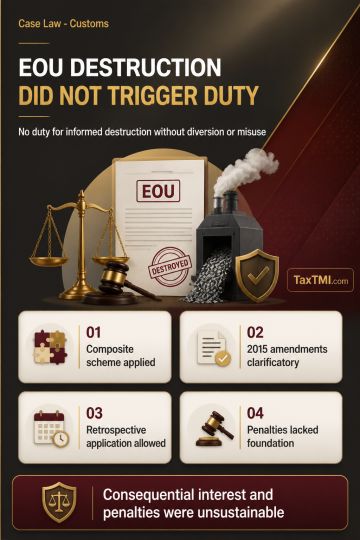
Specific tariff classification for ophthalmic instruments and extended limitation principles determine the treatment of duty demands, confiscation, an...
Framing of charges - Owning of assets disproportionate to known sources of income - Prevention of Corruption Act, 1988 - Case against the Additional Chief Architect in New Delhi Municipal Corporation - The Supreme Court held that findings in income tax proceedings, including those by the ITAT, do not have a direct bearing on criminal proceedings under the Prevention of Corruption Act. It stressed that the two processes serve different legal purposes and operate under distinct standards of proof. - The Court clarified that exoneration in a civil adjudication (like income tax proceedings) does not automatically negate the possibility of criminal liability under different statutes, emphasizing the independent nature of criminal proceedings concerning the alleged acquisition of disproportionate assets.
Framing of charges - Owning of assets disproportionate to known sources of income - Prevention of Corruption Act, 1988 - Case against the Additional Chief Architect in New Delhi Municipal Corporation - The Supreme Court held that findings in income tax proceedings, including those by the ITAT, do not have a direct bearing on criminal proceedings under the Prevention of Corruption Act. It stressed that the two processes serve different legal purposes and operate under distinct standards of proof. - The Court clarified that exoneration in a civil adjudication (like income tax proceedings) does not automatically negate the possibility of criminal liability under different statutes, emphasizing the independent nature of criminal proceedings concerning the alleged acquisition of disproportionate assets.
Note: It is a system-generated summary and is for quick reference only.
 TaxTMI
 of 4800





















 Join Channel


 TaxTMI