Development agreements require legal possession or effective enjoyment for capital gains transfer; permissive possession and deferred consideration de...
Prolonged sterilisation of development rights supports capital-gains treatment, while business-income disallowances cannot govern capital-gains comput...
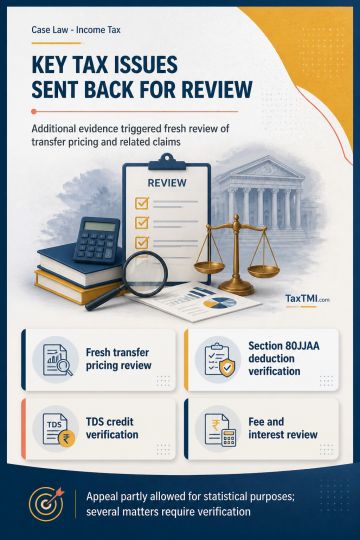
Additional evidence in transfer pricing dispute leads to fresh examination, while tax deductions, TDS credit, fee and refund interest require verifica...
Category II AIF pass-through taxation preserves non-business income character; investment receipts cannot be reclassified without applying recognised ...
Mutual fund maturity rules require proper rollover, redemption, disclosure, and due diligence; investor gains cannot excuse regulatory breaches or pen...
Attachment of Properties - The Custodian sought to recover significant sums from different individuals or entities, claiming they were indebted to the notified party. - The Special Court directed the appellant to pay a sum of Rs. 50 lakhs with Interest - diversion of funds from the banks/FIs to the individual accounts of certain brokers - The Supreme Court addressed several key issues arising from the appeals under the Act of 1992, including the notification of individuals, recovery of dues, and the burden of proof. It clarified that property attachment under the Act occurs from the date of notification forward, not retroactively. The SC found it insufficient to establish the appellants' liabilities. Moreover, it emphasized the Custodian's responsibility to prove the debts before shifting the burden onto the appellants. Consequently, the Court ruled in favor of the appellants, quashing the judgments and allowing the appeals.
Attachment of Properties - The Custodian sought to recover significant sums from different individuals or entities, claiming they were indebted to the notified party. - The Special Court directed the appellant to pay a sum of Rs. 50 lakhs with Interest - diversion of funds from the banks/FIs to the individual accounts of certain brokers - The Supreme Court addressed several key issues arising from the appeals under the Act of 1992, including the notification of individuals, recovery of dues, and the burden of proof. It clarified that property attachment under the Act occurs from the date of notification forward, not retroactively. The SC found it insufficient to establish the appellants' liabilities. Moreover, it emphasized the Custodian's responsibility to prove the debts before shifting the burden onto the appellants. Consequently, the Court ruled in favor of the appellants, quashing the judgments and allowing the appeals.
Note: It is a system-generated summary and is for quick reference only.
 TaxTMI
 of 4807




















 Join Channel


 TaxTMI