Defined public benefit can retain charitable character; registration renewal requires examining genuine activities and legal compliance, not surplus a...
Capital reduction is distinct from share buy-back, preventing buy-back tax; restructuring interest and related business deductions also survive scruti...
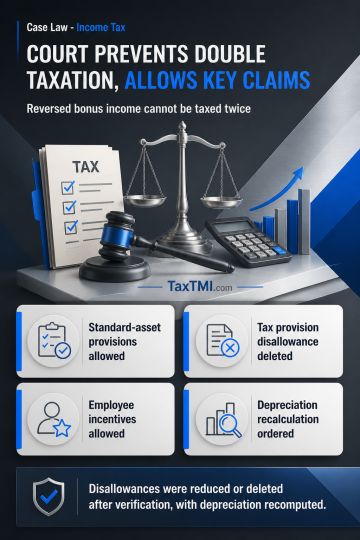
Transfer pricing and tax deductions upheld on established principles, while employee contributions and warranty provisions returned for fresh examinat...
Captive transfer pricing relies on industrial consumer tariffs, while genuine quotations can benchmark effluent treatment transfers under the Other Me...
Specific tariff classification for ophthalmic instruments and extended limitation principles determine the treatment of duty demands, confiscation, an...
Integrated golf function determines classification, placing launch monitors and simulators under other golf equipment rather than measuring instrument...
Attachment of Properties - The Custodian sought to recover significant sums from different individuals or entities, claiming they were indebted to the notified party. - The Special Court directed the appellant to pay a sum of Rs. 50 lakhs with Interest - diversion of funds from the banks/FIs to the individual accounts of certain brokers - The Supreme Court addressed several key issues arising from the appeals under the Act of 1992, including the notification of individuals, recovery of dues, and the burden of proof. It clarified that property attachment under the Act occurs from the date of notification forward, not retroactively. The SC found it insufficient to establish the appellants' liabilities. Moreover, it emphasized the Custodian's responsibility to prove the debts before shifting the burden onto the appellants. Consequently, the Court ruled in favor of the appellants, quashing the judgments and allowing the appeals.
Attachment of Properties - The Custodian sought to recover significant sums from different individuals or entities, claiming they were indebted to the notified party. - The Special Court directed the appellant to pay a sum of Rs. 50 lakhs with Interest - diversion of funds from the banks/FIs to the individual accounts of certain brokers - The Supreme Court addressed several key issues arising from the appeals under the Act of 1992, including the notification of individuals, recovery of dues, and the burden of proof. It clarified that property attachment under the Act occurs from the date of notification forward, not retroactively. The SC found it insufficient to establish the appellants' liabilities. Moreover, it emphasized the Custodian's responsibility to prove the debts before shifting the burden onto the appellants. Consequently, the Court ruled in favor of the appellants, quashing the judgments and allowing the appeals.
Note: It is a system-generated summary and is for quick reference only.
 TaxTMI
 of 4807





















 Join Channel


 TaxTMI
