Commercial vehicle depreciation, scientifically determined warranty provisions and exempt-income disallowances were resolved in favour of the taxpayer...
Inherited property sale proceeds require capital-gains treatment where ownership is supported by evidence, not suspicion or unverified signature doubt...
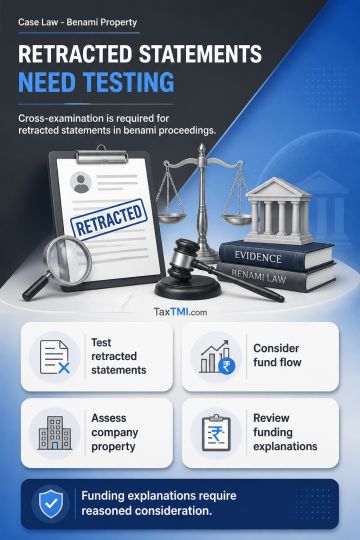
Cross-examination of retracted statements is essential where foundational evidence supports a benami allegation and documented funding explanations re...
Capital-goods exemption covers plant-modernisation accessories, while the import restriction applies only to earlier capital-goods components and spar...
Attachment of Properties - The Custodian sought to recover significant sums from different individuals or entities, claiming they were indebted to the notified party. - The Special Court directed the appellant to pay a sum of Rs. 50 lakhs with Interest - diversion of funds from the banks/FIs to the individual accounts of certain brokers - The Supreme Court addressed several key issues arising from the appeals under the Act of 1992, including the notification of individuals, recovery of dues, and the burden of proof. It clarified that property attachment under the Act occurs from the date of notification forward, not retroactively. The SC found it insufficient to establish the appellants' liabilities. Moreover, it emphasized the Custodian's responsibility to prove the debts before shifting the burden onto the appellants. Consequently, the Court ruled in favor of the appellants, quashing the judgments and allowing the appeals.
Attachment of Properties - The Custodian sought to recover significant sums from different individuals or entities, claiming they were indebted to the notified party. - The Special Court directed the appellant to pay a sum of Rs. 50 lakhs with Interest - diversion of funds from the banks/FIs to the individual accounts of certain brokers - The Supreme Court addressed several key issues arising from the appeals under the Act of 1992, including the notification of individuals, recovery of dues, and the burden of proof. It clarified that property attachment under the Act occurs from the date of notification forward, not retroactively. The SC found it insufficient to establish the appellants' liabilities. Moreover, it emphasized the Custodian's responsibility to prove the debts before shifting the burden onto the appellants. Consequently, the Court ruled in favor of the appellants, quashing the judgments and allowing the appeals.
Note: It is a system-generated summary and is for quick reference only.
 TaxTMI
 of 4801





















 Join Channel


 TaxTMI