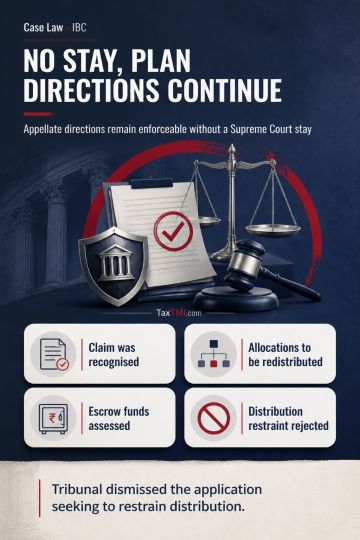
Enforcement of resolution-plan directions continues without a Supreme Court stay, preventing suspension of redistribution and escrowed-fund distributi...
Third-party ownership claims over attached property require Special Court adjudication where purchasers lack registered sale deeds and bona fides rema...
Pure-agent reimbursements in clearing and forwarding services are excluded from taxable value when qualifying third-party payments are properly record...
Customs relief for Strait of Hormuz maritime disruptions remains available, with existing conditions continuing unchanged through the extended validit...
Attachment of Properties - The Custodian sought to recover significant sums from different individuals or entities, claiming they were indebted to the notified party. - The Special Court directed the appellant to pay a sum of Rs. 50 lakhs with Interest - diversion of funds from the banks/FIs to the individual accounts of certain brokers - The Supreme Court addressed several key issues arising from the appeals under the Act of 1992, including the notification of individuals, recovery of dues, and the burden of proof. It clarified that property attachment under the Act occurs from the date of notification forward, not retroactively. The SC found it insufficient to establish the appellants' liabilities. Moreover, it emphasized the Custodian's responsibility to prove the debts before shifting the burden onto the appellants. Consequently, the Court ruled in favor of the appellants, quashing the judgments and allowing the appeals.
Attachment of Properties - The Custodian sought to recover significant sums from different individuals or entities, claiming they were indebted to the notified party. - The Special Court directed the appellant to pay a sum of Rs. 50 lakhs with Interest - diversion of funds from the banks/FIs to the individual accounts of certain brokers - The Supreme Court addressed several key issues arising from the appeals under the Act of 1992, including the notification of individuals, recovery of dues, and the burden of proof. It clarified that property attachment under the Act occurs from the date of notification forward, not retroactively. The SC found it insufficient to establish the appellants' liabilities. Moreover, it emphasized the Custodian's responsibility to prove the debts before shifting the burden onto the appellants. Consequently, the Court ruled in favor of the appellants, quashing the judgments and allowing the appeals.
Note: It is a system-generated summary and is for quick reference only.
 TaxTMI
 of 4801


















 Join Channel


 TaxTMI