Development agreements require legal possession or effective enjoyment for capital gains transfer; permissive possession and deferred consideration de...
Prolonged sterilisation of development rights supports capital-gains treatment, while business-income disallowances cannot govern capital-gains comput...
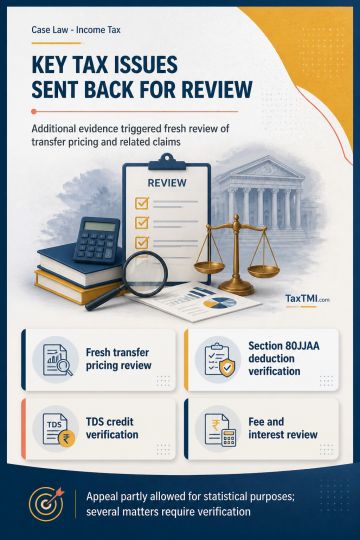
Additional evidence in transfer pricing dispute leads to fresh examination, while tax deductions, TDS credit, fee and refund interest require verifica...
Category II AIF pass-through taxation preserves non-business income character; investment receipts cannot be reclassified without applying recognised ...
Mutual fund maturity rules require proper rollover, redemption, disclosure, and due diligence; investor gains cannot excuse regulatory breaches or pen...
Page of 4813
Press 'Enter' after typing page number.
1461 to 1480 of 96257 Results
❮
❯
❯❯
0 / 200
Expand Note
Add to Folder
No Folders have been created
+
Are you sure you want to delete "My most important" ?
Demand of GST - Validity of assessment orders - The petitioner contended that they provided all relevant documents, including those related to land transactions, during the assessment process. They argued that project details were submitted during rectification proceedings. - After examining the evidence and submissions, the court noted that the assessing officer had considered the petitioner's documents and entered findings based on such evidence. The court concluded that a reasonable opportunity was provided to the petitioner, and the assessment orders were not a result of non-application of mind. Therefore, the court found no grounds for interference in its discretionary jurisdiction.
Demand of GST - Validity of assessment orders - The petitioner contended that they provided all relevant documents, including those related to land transactions, during the assessment process. They argued that project details were submitted during rectification proceedings. - After examining the evidence and submissions, the court noted that the assessing officer had considered the petitioner's documents and entered findings based on such evidence. The court concluded that a reasonable opportunity was provided to the petitioner, and the assessment orders were not a result of non-application of mind. Therefore, the court found no grounds for interference in its discretionary jurisdiction.
Note: It is a system-generated summary and is for quick reference only.
 TaxTMI
  TaxTMI
 of 4813


















 Join Channel