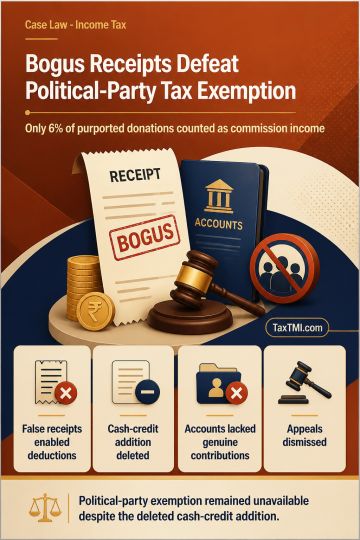
Bogus donation receipts justified commission income assessment and defeated political-party tax exemption for inaccurate accounts and reporting failur...
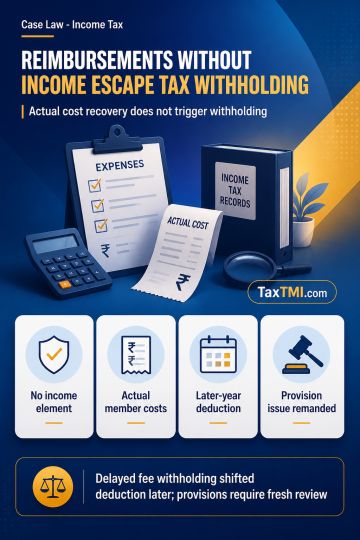
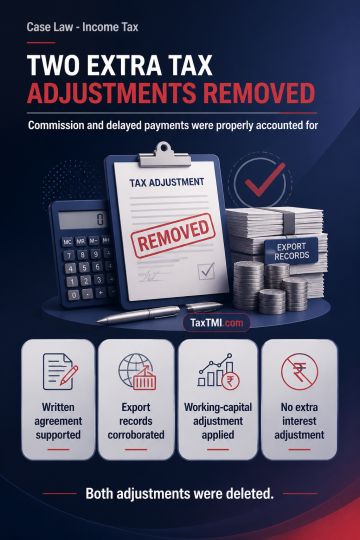
Pure reimbursement without income element escapes tax withholding, while delayed withholding and unsupported provisions face deferred or renewed scrut...
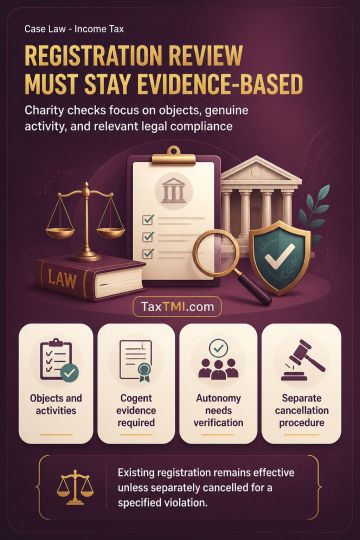
Public benefit requirement defeats charitable registration where residents' association services are reciprocal, member-only facilities governed by mu...
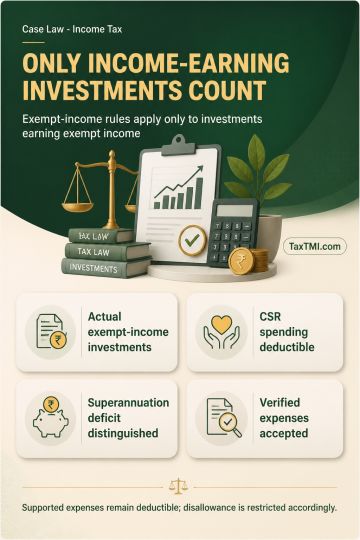
Exempt-income expenditure disallowance is confined to investments that actually generated exempt income, while supported business expenses remain dedu...
Objective characteristics and principal use govern mining-tyre classification, while fresh advance ruling applications may rely on additional technica...
Page of 4805
Press 'Enter' after typing page number.
801 to 820 of 96091 Results
❮
❯
❯❯
0 / 200
Expand Note
Add to Folder
No Folders have been created
+
Are you sure you want to delete "My most important" ?
Misclassification and Wrongful Claim of MEIS Benefits - Exports of quilts containing cotton/polyester - Levy of penalties - The CESTAT found the appellant guilty of willful misdeclaration and misclassification to avail higher MEIS benefits, violating the provisions of the Customs Act, 1962, and Foreign Trade (Development & Regulation) Act, 1992. - The Tribunal upheld the principle of self-assessment and confirmed that M/s FA's actions constituted a deliberate contravention of customs laws, making them liable for penalties. - While penalties were justified for the firm due to the deliberate misclassification, the penalties against the individual managers were revoked, acknowledging their passive role in following the firm's instructions without evidence of personal gain or active connivance.
Misclassification and Wrongful Claim of MEIS Benefits - Exports of quilts containing cotton/polyester - Levy of penalties - The CESTAT found the appellant guilty of willful misdeclaration and misclassification to avail higher MEIS benefits, violating the provisions of the Customs Act, 1962, and Foreign Trade (Development & Regulation) Act, 1992. - The Tribunal upheld the principle of self-assessment and confirmed that M/s FA's actions constituted a deliberate contravention of customs laws, making them liable for penalties. - While penalties were justified for the firm due to the deliberate misclassification, the penalties against the individual managers were revoked, acknowledging their passive role in following the firm's instructions without evidence of personal gain or active connivance.
Note: It is a system-generated summary and is for quick reference only.
 TaxTMI
 of 4805




 Join Channel


 TaxTMI