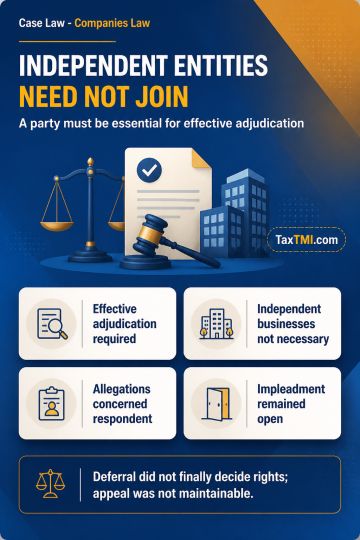
Necessary-party requirements limit impleadment of independent entities, while deferred consideration does not create an appealable adverse determinati...
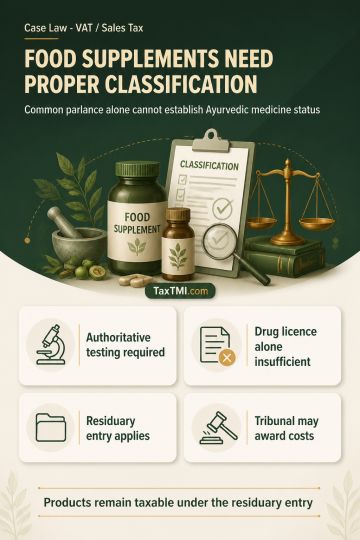
Food supplement classification requires common parlance and authoritative tests, preventing treatment as proprietary Ayurvedic medicines without suppo...
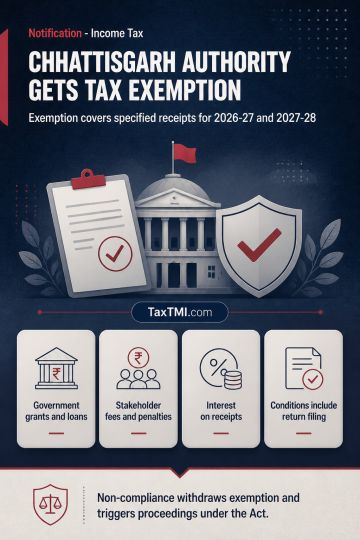
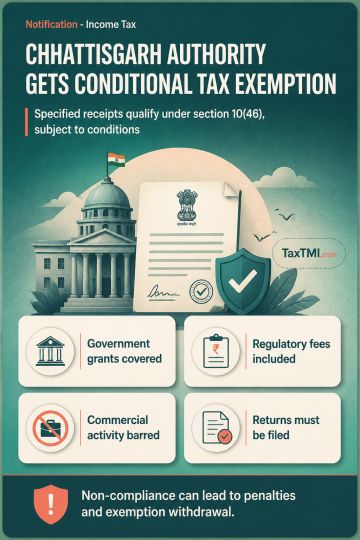
Specified regulatory authority income receives conditional tax exemption, subject to non-commercial activity, unchanged income character, and return f...
Tax exemption for regulatory authority income applies retrospectively, subject to non-commercial activity, unchanged income sources, and return-filing...
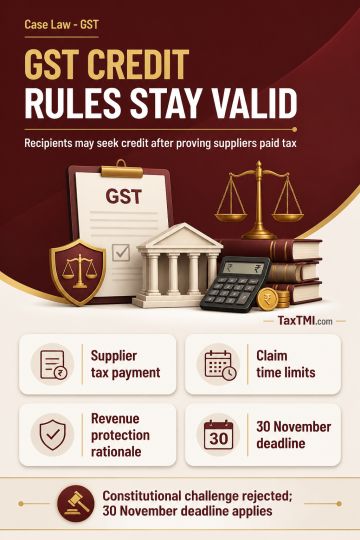
Input tax credit conditions remain constitutionally valid, with eligible recipient claims considered under GST circulars and retrospective filing dead...
Misclassification and Wrongful Claim of MEIS Benefits - Exports of quilts containing cotton/polyester - Levy of penalties - The CESTAT found the appellant guilty of willful misdeclaration and misclassification to avail higher MEIS benefits, violating the provisions of the Customs Act, 1962, and Foreign Trade (Development & Regulation) Act, 1992. - The Tribunal upheld the principle of self-assessment and confirmed that M/s FA's actions constituted a deliberate contravention of customs laws, making them liable for penalties. - While penalties were justified for the firm due to the deliberate misclassification, the penalties against the individual managers were revoked, acknowledging their passive role in following the firm's instructions without evidence of personal gain or active connivance.
Misclassification and Wrongful Claim of MEIS Benefits - Exports of quilts containing cotton/polyester - Levy of penalties - The CESTAT found the appellant guilty of willful misdeclaration and misclassification to avail higher MEIS benefits, violating the provisions of the Customs Act, 1962, and Foreign Trade (Development & Regulation) Act, 1992. - The Tribunal upheld the principle of self-assessment and confirmed that M/s FA's actions constituted a deliberate contravention of customs laws, making them liable for penalties. - While penalties were justified for the firm due to the deliberate misclassification, the penalties against the individual managers were revoked, acknowledging their passive role in following the firm's instructions without evidence of personal gain or active connivance.
Note: It is a system-generated summary and is for quick reference only.
 TaxTMI
 of 4805






 Join Channel


 TaxTMI
