Development agreements require legal possession or effective enjoyment for capital gains transfer; permissive possession and deferred consideration de...
Prolonged sterilisation of development rights supports capital-gains treatment, while business-income disallowances cannot govern capital-gains comput...
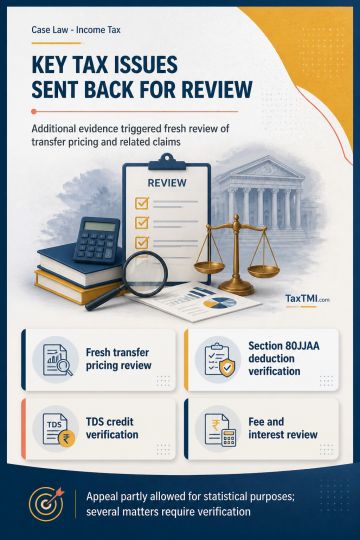
Additional evidence in transfer pricing dispute leads to fresh examination, while tax deductions, TDS credit, fee and refund interest require verifica...
Category II AIF pass-through taxation preserves non-business income character; investment receipts cannot be reclassified without applying recognised ...
Mutual fund maturity rules require proper rollover, redemption, disclosure, and due diligence; investor gains cannot excuse regulatory breaches or pen...
Disciplinary proceedings - allegation of misconduct - Proceedings against ex-Superintendent of Central Excise - Reliance on confessional statements made by accused persons during the investigation - The High court underscored that disciplinary proceedings require evidence that meets legal principles, and reliance on confessional statements from a separate criminal investigation fails to satisfy this criterion. - It was concluded that the punishment orders were based on improper grounds, as the disciplinary actions were not supported by evidence that could logically prove the charges against the employees according to principles applicable to departmental inquiries. Thus, the punishment orders and the appellate decisions affirming them were quashed, and the employees were entitled to consequential benefits.
Disciplinary proceedings - allegation of misconduct - Proceedings against ex-Superintendent of Central Excise - Reliance on confessional statements made by accused persons during the investigation - The High court underscored that disciplinary proceedings require evidence that meets legal principles, and reliance on confessional statements from a separate criminal investigation fails to satisfy this criterion. - It was concluded that the punishment orders were based on improper grounds, as the disciplinary actions were not supported by evidence that could logically prove the charges against the employees according to principles applicable to departmental inquiries. Thus, the punishment orders and the appellate decisions affirming them were quashed, and the employees were entitled to consequential benefits.
Note: It is a system-generated summary and is for quick reference only.
 TaxTMI
 of 4807
















 Join Channel


 TaxTMI