Inherited property sale proceeds require capital-gains treatment where ownership is supported by evidence, not suspicion or unverified signature doubt...
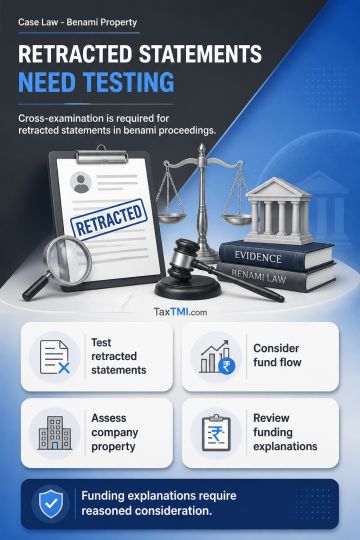
Cross-examination of retracted statements is essential where foundational evidence supports a benami allegation and documented funding explanations re...
Capital-goods exemption covers plant-modernisation accessories, while the import restriction applies only to earlier capital-goods components and spar...
Constitutional judicial review permits challenges to ECIRs and connected money-laundering proceedings where coercive action affects fundamental intere...
Unexplained credits u/s. 68 - cash claimed to have been received by the assessee from recovery of farmers' advances earlier granted - onus to prove - The ITAT upheld the CIT(A)'s decision, finding that the assessee, a corporate entity engaged in sugar manufacturing, had regularly advanced money to sugarcane farmers to secure raw materials. These advances, reflected in the financial statements as 'receivables', were substantiated by the assessee through various documents and submissions during the assessment proceedings. - The ITAT found no basis to classify these deposits as unexplained under Section 68 or Section 69A of the Act. The tribunal emphasized that the AO's addition constituted a double addition for the same amount in two different assessment years, which was unjustified.
Unexplained credits u/s. 68 - cash claimed to have been received by the assessee from recovery of farmers' advances earlier granted - onus to prove - The ITAT upheld the CIT(A)'s decision, finding that the assessee, a corporate entity engaged in sugar manufacturing, had regularly advanced money to sugarcane farmers to secure raw materials. These advances, reflected in the financial statements as 'receivables', were substantiated by the assessee through various documents and submissions during the assessment proceedings. - The ITAT found no basis to classify these deposits as unexplained under Section 68 or Section 69A of the Act. The tribunal emphasized that the AO's addition constituted a double addition for the same amount in two different assessment years, which was unjustified.
Note: It is a system-generated summary and is for quick reference only.
 TaxTMI
 of 4786



















 Join Channel


 TaxTMI