Development agreements require legal possession or effective enjoyment for capital gains transfer; permissive possession and deferred consideration de...
Prolonged sterilisation of development rights supports capital-gains treatment, while business-income disallowances cannot govern capital-gains comput...
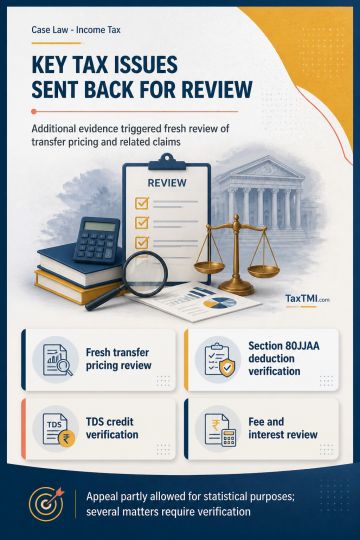
Additional evidence in transfer pricing dispute leads to fresh examination, while tax deductions, TDS credit, fee and refund interest require verifica...
Category II AIF pass-through taxation preserves non-business income character; investment receipts cannot be reclassified without applying recognised ...
Unexplained credits u/s. 68 - cash claimed to have been received by the assessee from recovery of farmers' advances earlier granted - onus to prove - The ITAT upheld the CIT(A)'s decision, finding that the assessee, a corporate entity engaged in sugar manufacturing, had regularly advanced money to sugarcane farmers to secure raw materials. These advances, reflected in the financial statements as 'receivables', were substantiated by the assessee through various documents and submissions during the assessment proceedings. - The ITAT found no basis to classify these deposits as unexplained under Section 68 or Section 69A of the Act. The tribunal emphasized that the AO's addition constituted a double addition for the same amount in two different assessment years, which was unjustified.
Unexplained credits u/s. 68 - cash claimed to have been received by the assessee from recovery of farmers' advances earlier granted - onus to prove - The ITAT upheld the CIT(A)'s decision, finding that the assessee, a corporate entity engaged in sugar manufacturing, had regularly advanced money to sugarcane farmers to secure raw materials. These advances, reflected in the financial statements as 'receivables', were substantiated by the assessee through various documents and submissions during the assessment proceedings. - The ITAT found no basis to classify these deposits as unexplained under Section 68 or Section 69A of the Act. The tribunal emphasized that the AO's addition constituted a double addition for the same amount in two different assessment years, which was unjustified.
Note: It is a system-generated summary and is for quick reference only.
 TaxTMI
 of 4805
















 Join Channel


 TaxTMI
