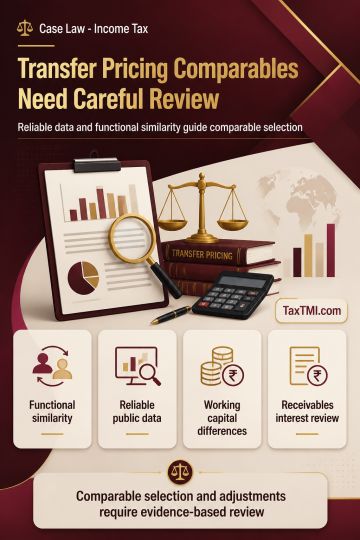
Transfer pricing comparability requires functional alignment, reliable financial data, and careful review of working capital and receivables adjustmen...
Transfer pricing rules require benchmarking corporate guarantees and associated-enterprise advances, while invalid domestic-transaction adjustments ca...
Prospective sugar export prohibition required registered letters of credit; private contracts and export quotas created no enforceable continuation ri...
Retroactive interim-moratorium exclusion permits protective asset disclosure and preservation measures against personal guarantors pending arbitration...
Unexplained credits u/s. 68 - cash claimed to have been received by the assessee from recovery of farmers' advances earlier granted - onus to prove - The ITAT upheld the CIT(A)'s decision, finding that the assessee, a corporate entity engaged in sugar manufacturing, had regularly advanced money to sugarcane farmers to secure raw materials. These advances, reflected in the financial statements as 'receivables', were substantiated by the assessee through various documents and submissions during the assessment proceedings. - The ITAT found no basis to classify these deposits as unexplained under Section 68 or Section 69A of the Act. The tribunal emphasized that the AO's addition constituted a double addition for the same amount in two different assessment years, which was unjustified.
Unexplained credits u/s. 68 - cash claimed to have been received by the assessee from recovery of farmers' advances earlier granted - onus to prove - The ITAT upheld the CIT(A)'s decision, finding that the assessee, a corporate entity engaged in sugar manufacturing, had regularly advanced money to sugarcane farmers to secure raw materials. These advances, reflected in the financial statements as 'receivables', were substantiated by the assessee through various documents and submissions during the assessment proceedings. - The ITAT found no basis to classify these deposits as unexplained under Section 68 or Section 69A of the Act. The tribunal emphasized that the AO's addition constituted a double addition for the same amount in two different assessment years, which was unjustified.
Note: It is a system-generated summary and is for quick reference only.
 TaxTMI
 of 4792

















 Join Channel


 TaxTMI