Business expenditure deduction requires proof of genuine commission payments and commercial allowability; turnover growth alone cannot validate the cl...
Article 8 treaty coverage excluded third-party airline support services, while documented demonetisation cash receipts remained accepted business inco...
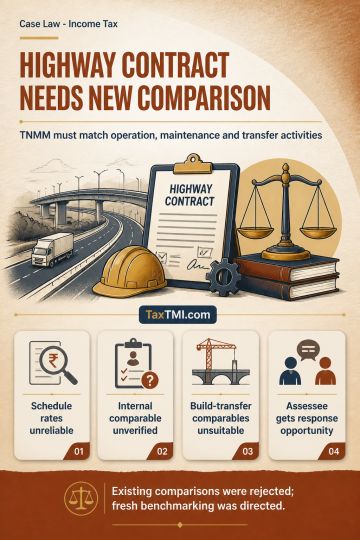
Functional comparability under TNMM requires highway contract benchmarks to reflect operation, maintenance and transfer activities, requiring fresh be...
Principles of unjust enrichment - Refund amount ordered to be credited to the Consumer Welfare Fund instead of being paid to the appellant - The Tribunal interprets Clause (e) of the third proviso to section 11B of the Central Excise Act, 1944, and concludes that the appellant had indeed borne the burden of the duty and had not passed it on to any other party. - Based on the findings, the Tribunal determines that the appellant is entitled to the refund amount along with interest, which should be reimbursed directly to the appellant instead of being credited to the Consumer Welfare Fund.
Principles of unjust enrichment - Refund amount ordered to be credited to the Consumer Welfare Fund instead of being paid to the appellant - The Tribunal interprets Clause (e) of the third proviso to section 11B of the Central Excise Act, 1944, and concludes that the appellant had indeed borne the burden of the duty and had not passed it on to any other party. - Based on the findings, the Tribunal determines that the appellant is entitled to the refund amount along with interest, which should be reimbursed directly to the appellant instead of being credited to the Consumer Welfare Fund.
Note: It is a system-generated summary and is for quick reference only.
 TaxTMI
 of 4805











 Join Channel


 TaxTMI