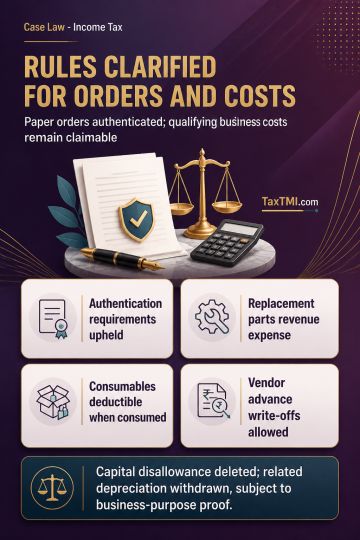
Authentication of paper assessment orders upheld, while qualifying repairs, consumables and vendor advance write-offs remain deductible business claim...
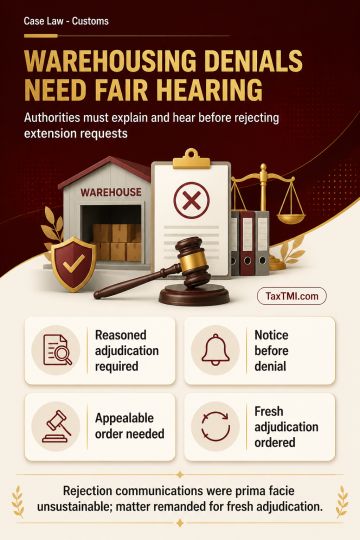
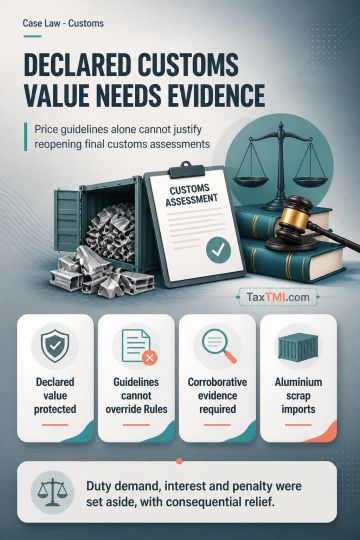
Transaction value cannot be rejected solely on non-statutory valuation guidelines without corroborative evidence supporting reassessment of final cust...
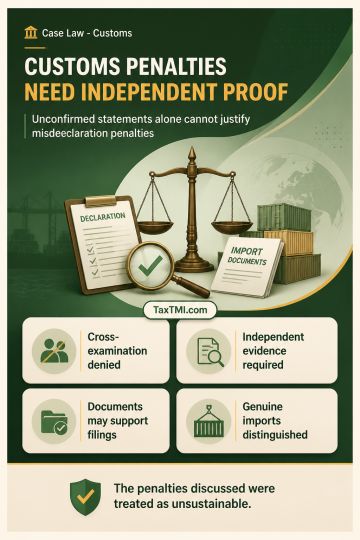
Cross-examination rights and corroborated evidence limit customs penalties for misdeclaration in genuine import transactions involving documented clea...
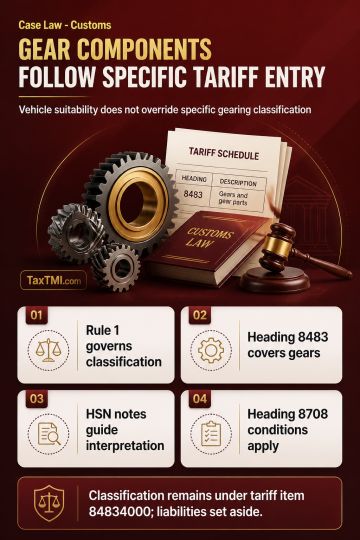
Tariff classification of vehicle gear components follows the specific gearing entry, displacing motor-vehicle parts classification and related liabili...
CENVAT Credit - common inputs/input services used for manufacture of stock transferred exempted goods (lime stone) and dutiable products (Cement/Clinker) - The Tribunal clarified that the presence of two different final products (limestone as exempted and cement/clinker as dutiable) necessitates the maintenance of separate accounts for inputs/input services used. The court rejected the appellant's interpretation and emphasized that the rules apply to their situation, thus upholding the demand for payment under Rule 6(3)(i) due to the appellant's failure to maintain separate accounts. - However, the CESTAT agreed with the appellant regarding the limitation period, noting no grounds for invoking the extended period due to the appellant's transparent documentation and periodic disclosures.
CENVAT Credit - common inputs/input services used for manufacture of stock transferred exempted goods (lime stone) and dutiable products (Cement/Clinker) - The Tribunal clarified that the presence of two different final products (limestone as exempted and cement/clinker as dutiable) necessitates the maintenance of separate accounts for inputs/input services used. The court rejected the appellant's interpretation and emphasized that the rules apply to their situation, thus upholding the demand for payment under Rule 6(3)(i) due to the appellant's failure to maintain separate accounts. - However, the CESTAT agreed with the appellant regarding the limitation period, noting no grounds for invoking the extended period due to the appellant's transparent documentation and periodic disclosures.
Note: It is a system-generated summary and is for quick reference only.
 TaxTMI
 of 4805





 Join Channel


 TaxTMI