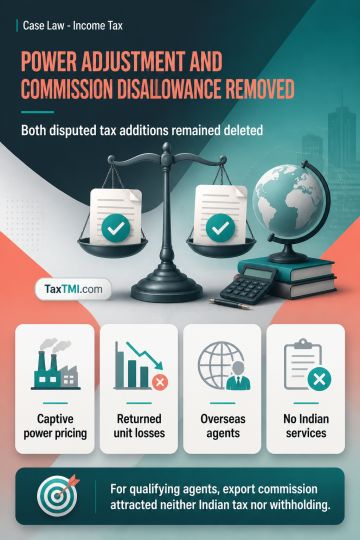
Business expenditure substantiation supports scrap credits, statutory payments and expense claims, while depreciation requires proof of actual busines...
Captive power transfer pricing and non-resident export commission rules support deletion of adjustments and withholding disallowance in discussed proc...
Page of 4807
Press 'Enter' after typing page number.
901 to 920 of 96136 Results
❮
❯
❯❯
0 / 200
Expand Note
Add to Folder
No Folders have been created
+
Are you sure you want to delete "My most important" ?
Forfeiture of the earnest money deposit by the appellant bank - The Supreme Court held that, the underlying principle envisaged u/s(s) 73 & 74 of the Indian Contract Act, 1872 which is a general law will have no application, when it comes to the SARFAESI Act more particularly the forfeiture of earnest-money deposit which has been statutorily provided under Rule 9(5) of the SARFAESI Rules as a consequence of the auction purchaser’s failure to deposit the balance amount. - The High Court erred in law by holding that forfeiture of the entire deposit under Rule 9 sub-rule (5) of the SARFAESI Rules by the appellant bank after having already recovered its dues from the subsequent sale amounts to unjust enrichment.
Forfeiture of the earnest money deposit by the appellant bank - The Supreme Court held that, the underlying principle envisaged u/s(s) 73 & 74 of the Indian Contract Act, 1872 which is a general law will have no application, when it comes to the SARFAESI Act more particularly the forfeiture of earnest-money deposit which has been statutorily provided under Rule 9(5) of the SARFAESI Rules as a consequence of the auction purchaser’s failure to deposit the balance amount. - The High Court erred in law by holding that forfeiture of the entire deposit under Rule 9 sub-rule (5) of the SARFAESI Rules by the appellant bank after having already recovered its dues from the subsequent sale amounts to unjust enrichment.
Note: It is a system-generated summary and is for quick reference only.
 TaxTMI
 of 4807



 Join Channel


 TaxTMI