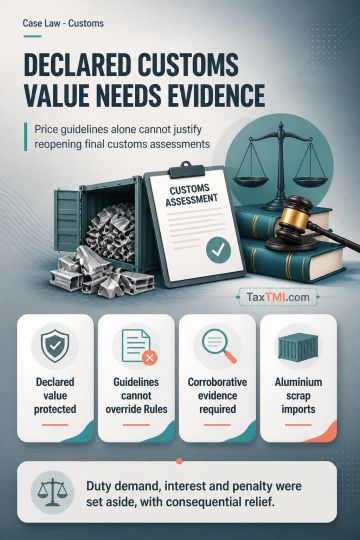
Transaction value cannot be rejected solely on non-statutory valuation guidelines without corroborative evidence supporting reassessment of final cust...
Cross-examination rights and corroborated evidence limit customs penalties for misdeclaration in genuine import transactions involving documented clea...
Tariff classification of vehicle gear components follows the specific gearing entry, displacing motor-vehicle parts classification and related liabili...
Necessary-party requirements limit impleadment of independent entities, while deferred consideration does not create an appealable adverse determinati...
Food supplement classification requires common parlance and authoritative tests, preventing treatment as proprietary Ayurvedic medicines without suppo...
Classification of imported goods - If every ‘flange’ available in the market could be used in any industry, then perhaps the classification under a single CTH would have served that purpose, but since one size does not fit all, different classifications are provided. The classification thus depends on, inter alia, functionality as well. Hence, when an item is imported for a specific purpose, if the Revenue does not believe in the classification declared by such importer, then the same could be rejected on some palpable evidence and if required, the Revenue could always insist upon further details / explanation insofar as the function / end-use claimed by such importer is concerned, in order to ascertain the chief/primary function, to arrive at the proper classification, otherwise the purpose of having two Customs Tariff Headings loses its significance, which is not the intention of legislature. - AT
Classification of imported goods - If every ‘flange’ available in the market could be used in any industry, then perhaps the classification under a single CTH would have served that purpose, but since one size does not fit all, different classifications are provided. The classification thus depends on, inter alia, functionality as well. Hence, when an item is imported for a specific purpose, if the Revenue does not believe in the classification declared by such importer, then the same could be rejected on some palpable evidence and if required, the Revenue could always insist upon further details / explanation insofar as the function / end-use claimed by such importer is concerned, in order to ascertain the chief/primary function, to arrive at the proper classification, otherwise the purpose of having two Customs Tariff Headings loses its significance, which is not the intention of legislature. - AT
Note: It is a system-generated summary and is for quick reference only.
 TaxTMI
 of 4805




















 Join Channel


 TaxTMI
