Inherited property sale proceeds require capital-gains treatment where ownership is supported by evidence, not suspicion or unverified signature doubt...
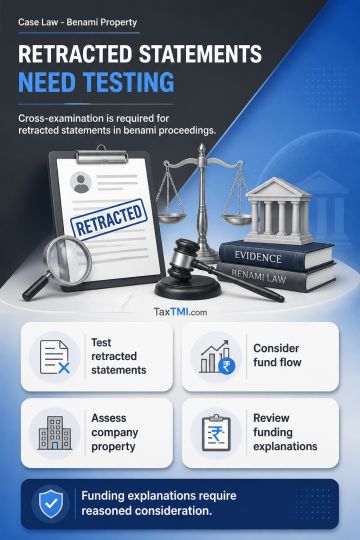
Cross-examination of retracted statements is essential where foundational evidence supports a benami allegation and documented funding explanations re...
Capital-goods exemption covers plant-modernisation accessories, while the import restriction applies only to earlier capital-goods components and spar...
Constitutional judicial review permits challenges to ECIRs and connected money-laundering proceedings where coercive action affects fundamental intere...
Constitutional Validity of Section 327(7) of the Companies Act, 2013 - statutory claims of the “workmen’s dues” - Overriding effect of the provisions of IBC - As sub-section (7) of Section 327 of the Act, 2013 provides that Sections 326 and 327 of the Act, 2013 shall not be applicable in the event of liquidation under the IBC, which has been necessitated in view of the enactment of IBC and it applies with respect to the liquidation of a company under the IBC, Section 327(7) of the Act, 2013 cannot be said to be arbitrary and/or violative of Article 21 of the Constitution of India - SC
Constitutional Validity of Section 327(7) of the Companies Act, 2013 - statutory claims of the “workmen’s dues” - Overriding effect of the provisions of IBC - As sub-section (7) of Section 327 of the Act, 2013 provides that Sections 326 and 327 of the Act, 2013 shall not be applicable in the event of liquidation under the IBC, which has been necessitated in view of the enactment of IBC and it applies with respect to the liquidation of a company under the IBC, Section 327(7) of the Act, 2013 cannot be said to be arbitrary and/or violative of Article 21 of the Constitution of India - SC
Note: It is a system-generated summary and is for quick reference only.
 TaxTMI
 of 4792













 Join Channel


 TaxTMI