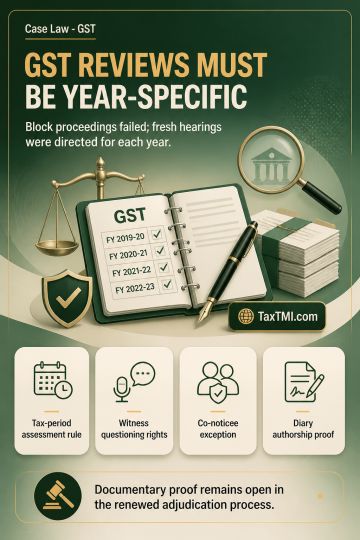
Cooperative society deposits, member-interest TDS exemption and credit-facility deduction claims require verification through records and supporting e...
Customs jurisdiction over EPCG condition breaches survives export-obligation discharge certificates, requiring alleged fraud and misdeclaration to be ...
Contractual tolerance requires consideration; breach recoveries, qualifying public infrastructure services and road works escape service tax liability...
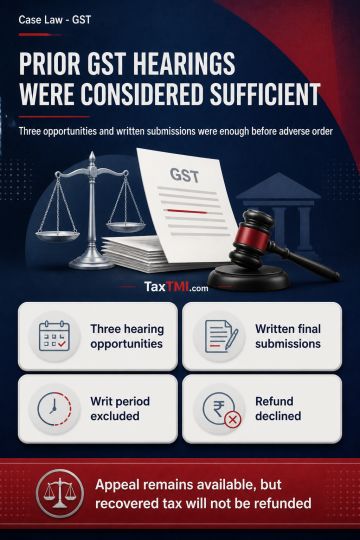
Personal hearing requirements in GST adjudication were satisfied by prior opportunities and written submissions; appellate limitation received writ-pe...
Binding nature of Tribunal Order - Principle of “consistency” - Not only the Tribunal but all the Authorities subordinate to it are bound to follow and comply with the law laid down by the Tribunal. This is necessary to maintain judicial discipline and avoid uncertainty in law. The Tribunal may, in appropriate cases, take a view different from the one taken by it earlier if there is change in law or the fact situation in the context whereof the law was declared by it earlier. The Assessing Authorities or the Statutory Appellate Authorities under the GST Act cannot and should not take a view on question of law contrary to the view taken by the Tribunal. - HC
Binding nature of Tribunal Order - Principle of “consistency” - Not only the Tribunal but all the Authorities subordinate to it are bound to follow and comply with the law laid down by the Tribunal. This is necessary to maintain judicial discipline and avoid uncertainty in law. The Tribunal may, in appropriate cases, take a view different from the one taken by it earlier if there is change in law or the fact situation in the context whereof the law was declared by it earlier. The Assessing Authorities or the Statutory Appellate Authorities under the GST Act cannot and should not take a view on question of law contrary to the view taken by the Tribunal. - HC
Note: It is a system-generated summary and is for quick reference only.
 TaxTMI
 of 4792











 Join Channel


 TaxTMI