Inherited property sale proceeds require capital-gains treatment where ownership is supported by evidence, not suspicion or unverified signature doubt...
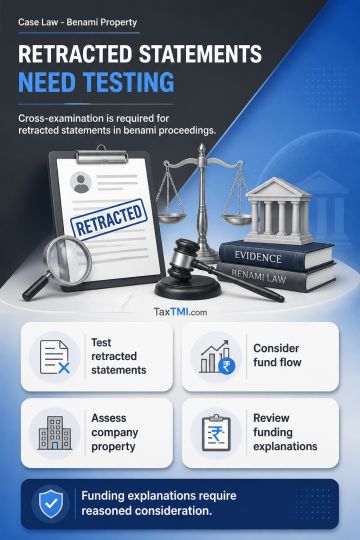
Cross-examination of retracted statements is essential where foundational evidence supports a benami allegation and documented funding explanations re...
Capital-goods exemption covers plant-modernisation accessories, while the import restriction applies only to earlier capital-goods components and spar...
Constitutional judicial review permits challenges to ECIRs and connected money-laundering proceedings where coercive action affects fundamental intere...
Dishonor of Cheque - a person, who has been held guilty u/s 138 of the Act of 1881 can be punished with imprisonment for a term which may extend up to two years, or with fine which may extend to twice the amount of the cheque or with both. Thus, there is a discretion left with the Criminal Court either to sentence the accused with imprisonment or to punish the accused with the sentence of fine upon considering the facts and circumstances of the case. Imposition of jail sentence is not mandatory for offence u/s 138 of the Act of 1881. - HC
Dishonor of Cheque - a person, who has been held guilty u/s 138 of the Act of 1881 can be punished with imprisonment for a term which may extend up to two years, or with fine which may extend to twice the amount of the cheque or with both. Thus, there is a discretion left with the Criminal Court either to sentence the accused with imprisonment or to punish the accused with the sentence of fine upon considering the facts and circumstances of the case. Imposition of jail sentence is not mandatory for offence u/s 138 of the Act of 1881. - HC
Note: It is a system-generated summary and is for quick reference only.
 TaxTMI
 of 4784





















 Join Channel


 TaxTMI