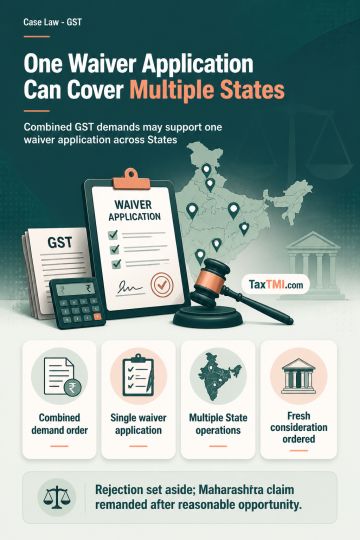
Invoice-based recovery claims remain time-barred despite separate winding-up proceedings, absent valid acknowledgment or part-payment of the disputed ...
Extended limitation fails without specific suppression allegations, while overseas employee secondment remains taxable as manpower supply within norma...
Time-share accommodation classification excludes Club or Association Service where purchasers receive contractual occupancy rights without genuine mem...
CENVAT credit for trading requires reversal, while taxable-service rental credit remains proportionately available and limitation issues await resolut...
Vicarious liability for dishonoured company cheques may extend to non-signatory directors where complaints contain foundational responsibility avermen...
Compounding of offence under Section 266G of the Companies Act, 1956 - on facts, the nature of offence which the company has charged does not invite with imprisonment or imprisonment and fine, but the penalty imposed is punishable with fine, which may extend upto five thousand rupees and where the contravention is continuing one, with a further fine, which may extend to five hundred rupees for everyday thereafter. Thus, the nature of offence is such that it is compoundable, and the same is just and proper. - HC
Compounding of offence under Section 266G of the Companies Act, 1956 - on facts, the nature of offence which the company has charged does not invite with imprisonment or imprisonment and fine, but the penalty imposed is punishable with fine, which may extend upto five thousand rupees and where the contravention is continuing one, with a further fine, which may extend to five hundred rupees for everyday thereafter. Thus, the nature of offence is such that it is compoundable, and the same is just and proper. - HC
Note: It is a system-generated summary and is for quick reference only.
 TaxTMI
 of 4803
















 Join Channel


 TaxTMI