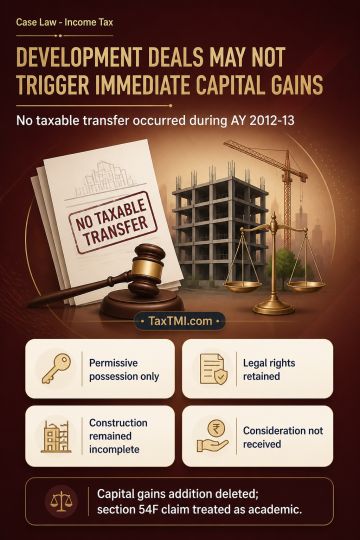
Development agreements require legal possession or effective enjoyment for capital gains transfer; permissive possession and deferred consideration de...
Prolonged sterilisation of development rights supports capital-gains treatment, while business-income disallowances cannot govern capital-gains comput...
Additional evidence in transfer pricing dispute leads to fresh examination, while tax deductions, TDS credit, fee and refund interest require verifica...
Category II AIF pass-through taxation preserves non-business income character; investment receipts cannot be reclassified without applying recognised ...
Insolvency and BankruptcyJuly 20, 2022Case LawsSCH
Power of NCLT to condone the delay beyond 15 days - Condonation of Delay of 27 days in filing for restoration was admitted - It is beyond comprehension as to how such a prescription as regards the period of filing the appeal and the limited period for condonation of delay in filing such appeal could be imported for the purpose of consideration of the prayer for condonation of delay in filing an application for restoration - No other provision has been brought to our notice which limits or curtails the powers of the Tribunal to condone the delay in filing the application for restoration. It needs hardly any reiteration that the rules or procedure are essentially intended to serve the cause of justice and are not for punishment of the parties in conduct of their matters. - SC
Power of NCLT to condone the delay beyond 15 days - Condonation of Delay of 27 days in filing for restoration was admitted - It is beyond comprehension as to how such a prescription as regards the period of filing the appeal and the limited period for condonation of delay in filing such appeal could be imported for the purpose of consideration of the prayer for condonation of delay in filing an application for restoration - No other provision has been brought to our notice which limits or curtails the powers of the Tribunal to condone the delay in filing the application for restoration. It needs hardly any reiteration that the rules or procedure are essentially intended to serve the cause of justice and are not for punishment of the parties in conduct of their matters. - SC
Note: It is a system-generated summary and is for quick reference only.
 TaxTMI
 of 4805

















 Join Channel


 TaxTMI
