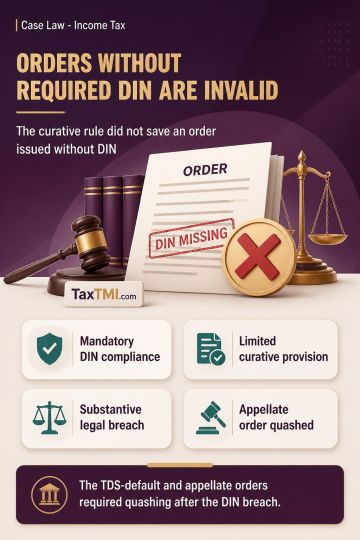
Document Identification Number compliance renders TDS-default orders invalid where mandatory DIN requirements are breached and curative provision does...
Reopening of assessment u/s 147 - Addition of on-money received by the assessee on sale of land - the sale consideration qua the transaction of sale of land in question, as disclosed in the registered sale deed, could not have been dislodged by the A.O on the basis of the contents of an uncertified copy of an “agreement to sell”, which on the basis of our aforesaid observations would not even be in the nature of a secondary evidence within the meaning of Sec. 63 of the Indian Evidence Act, 1872. - AT
Reopening of assessment u/s 147 - Addition of on-money received by the assessee on sale of land - the sale consideration qua the transaction of sale of land in question, as disclosed in the registered sale deed, could not have been dislodged by the A.O on the basis of the contents of an uncertified copy of an “agreement to sell”, which on the basis of our aforesaid observations would not even be in the nature of a secondary evidence within the meaning of Sec. 63 of the Indian Evidence Act, 1872. - AT
Note: It is a system-generated summary and is for quick reference only.
 TaxTMI
  TaxTMI
 of 4918